Dirty Cop Kicked Over a Veteran’s Motorcycle—Then Two Motorcycle Officers Arrived
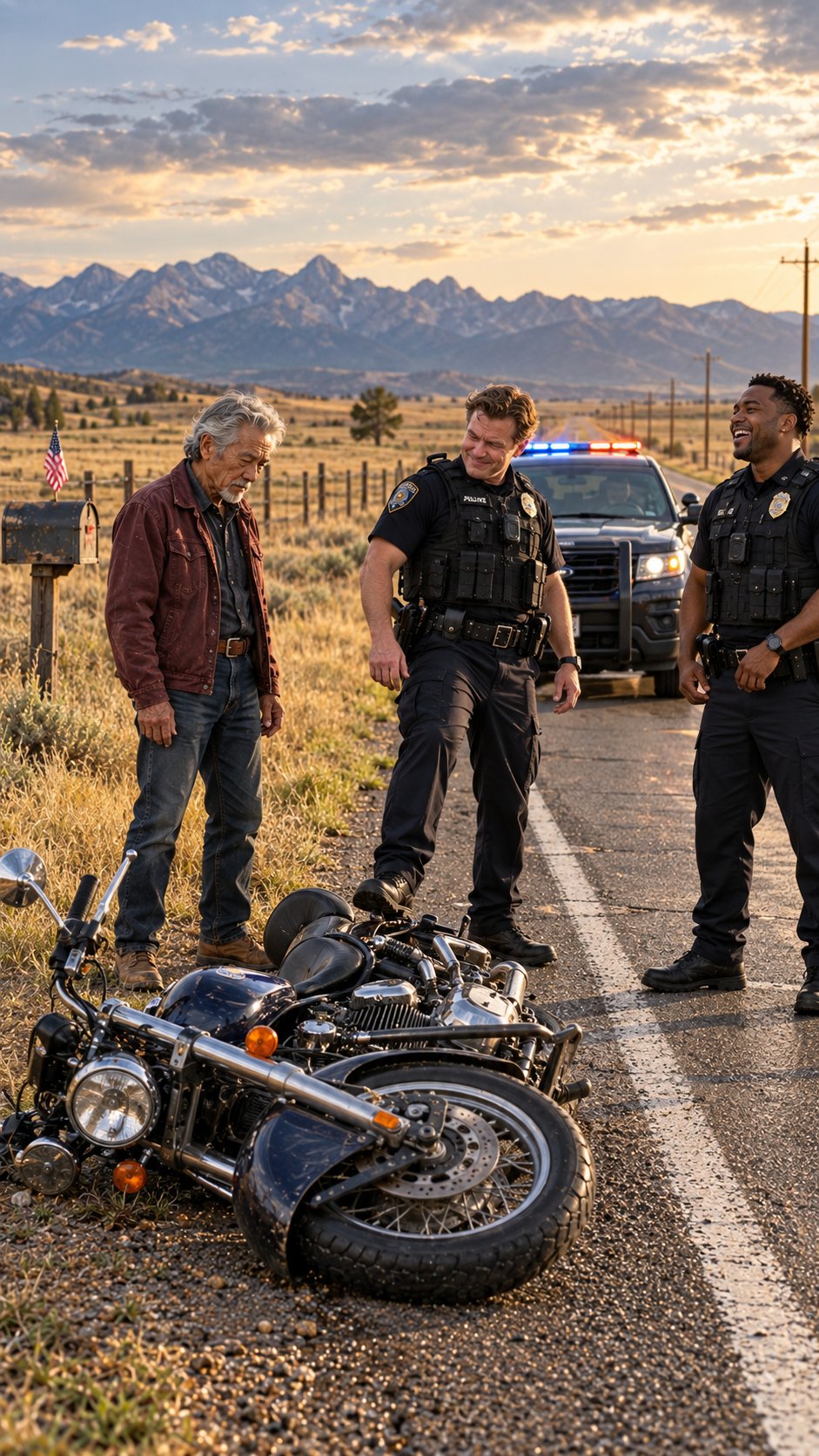
The motorcycle hit the pavement before I understood why the officer had lifted his boot.
CRASH.
Chrome struck asphalt.
The left mirror snapped inward.
The handlebar slammed down.
Gasoline sloshed inside the old tank.
For half a second, nobody moved.
Then the second officer laughed.
Not nervously.
Not because he was surprised.
He actually laughed.
Officer Travis Cole looked down at the motorcycle he'd just kicked over, then at me.
“PICK IT UP, OLD MAN.”
I was eighty-two years old.
My right knee had been replaced.
My left shoulder hadn't worked properly since 1994.
And the motorcycle lying on its side weighed more than five hundred pounds.
I looked at the bike.
Then at Cole.
“I wouldn't touch it again.”
His smile widened.
“OR WHAT?”
I didn't raise my voice.
“You'll see.”
His partner, Officer Wade Mercer, laughed harder.
“Oh, we're scared now.”
Cole stepped closer.
“You threatening a police officer?”
“No.”
“Sounded like a threat.”
“It was advice.”
That stopped his smile for maybe one second.
Then Mercer glanced over the roof of their cruiser.
His expression changed.
Two motorcycles had appeared on the highway behind them.
Police motorcycles.
Their emergency lights weren't flashing.
They weren't racing.
They were simply approaching in formation.
Cole looked over his shoulder.
“Friends of yours?”
I said nothing.
The motorcycles slowed.
The lead officer pulled onto the shoulder.
His partner followed.
Both killed their engines.
The lead motorcycle officer removed his helmet.
He was in his late forties, broad-shouldered, with a gray beginning at his temples.
He looked at Cole.
Then Mercer.
Then me.
Then the motorcycle lying on the pavement.
He froze.
Not because he recognized me.
Because he recognized the motorcycle.
He walked closer.
His eyes moved across the faded dark-blue tank, the worn leather seat, the old chrome crash bar, and finally the small brass plate mounted beneath the left side cover.
His face changed.
“Sir…”
He looked at me.
“Is that your motorcycle?”
I nodded.
“Yes.”
Cole's smile disappeared.
Mercer's laughter stopped.
The motorcycle officer crouched beside the fallen bike without touching it.
Then he looked up at Cole.
“What happened here?”
Cole answered immediately.
“He dropped it.”
The second motorcycle officer slowly turned toward him.
I said nothing.
The lead officer stood.
His nameplate read:
S. MADDOX.
Sergeant Samuel Maddox.
He looked at Cole again.
“You're saying he dropped this motorcycle?”
“That's what happened.”
Maddox glanced at me.
I was standing six feet away.
Helmet still in my left hand.
Gloves tucked beneath my belt.
No dust on my clothes.
No scraped palms.
No sign I'd fallen.
Then Maddox looked toward Cole's boots.
A fresh gray scrape marked the outer edge of Cole's right sole.
He looked back at the motorcycle.
A matching dusty mark crossed the lower saddlebag.
Nobody spoke.
Maddox finally asked:
“Officer Cole, is your body camera running?”
Cole's face changed.
And that—
not my age,
not my military service,
not the motorcycle,
not even the two officers who had just arrived—
was the moment I knew he understood exactly how much trouble he might be in.
My name is Raymond Walsh.
I was born in 1944.
I spent twenty-four years in the United States Army.
I retired decades before that afternoon on a two-lane highway in western Nebraska.
I wasn't a general.
I wasn't a colonel.
I didn't have secret connections in Washington.
No convoy was coming to rescue me.
I was simply an old man on an old motorcycle.
And that distinction matters.
Because what happened next wasn't supposed to depend on who I had once been.
It was supposed to depend on what two police officers had just done.
The motorcycle was a 1968 BMW R60/2.
Dark blue.
Mostly original.
Mechanically rebuilt twice.
Cosmetically imperfect.
Exactly how I wanted it.
People occasionally asked what it was worth.
I never knew how to answer.
There was a market value.
Then there was its value to me.
Those numbers had nothing to do with each other.
The bike had originally belonged to my older brother, Thomas.
Tom bought it used in 1971.
He was twenty-nine.
I was twenty-seven.
We were both young enough to believe we'd remain young forever.
Tom taught me how to ride it on a farm road outside North Platte.
I stalled it four times.
Nearly rode through a fence once.
He laughed until he couldn't breathe.
Tom died in 1987.
Cancer.
Forty-five years old.
Too young.
After the funeral, his wife asked if I wanted the motorcycle.
I said no.
Not because I didn't want it.
Because I couldn't imagine riding it without hearing him.
She kept it in a garage.
Five years later, she called again.
“Ray, either you take Tom's bike or I'm selling it.”
I drove over that weekend.
The tires were flat.
Battery dead.
Fuel system ruined.
Dust everywhere.
I sat on the seat for twenty minutes.
Then brought it home.
My wife, Eleanor, thought I'd lost my mind.
“You already have a motorcycle.”
“This is Tom's.”
“You don't need two.”
“This isn't about need.”
She looked at me.
Then smiled.
“That's usually what people say before spending money.”
She was right.
The restoration took eighteen months.
I kept the paint.
Every scratch I reasonably could.
Rebuilt what needed rebuilding.
Replaced what couldn't be saved.
The small brass plate under the side cover came later.
It read:
THOMAS J. WALSH
1942–1987
KEEP RIDING
Nothing military.
Nothing official.
Just my brother.
By eighty-two, I didn't ride far often.
My children hated when I rode at all.
My daughter, Claire, lived in Colorado and called the motorcycle “Dad's rolling argument against common sense.”
My son, Daniel, lived in Omaha and was less diplomatic.
“Sell it.”
“No.”
“You're eighty-two.”
“I can count.”
“What happens when you can't hold it up?”
“I stop riding.”
“How will you know?”
“When I can't hold it up.”
This conversation happened approximately every six weeks.
That September morning, the weather was nearly perfect.
Cool.
Dry.
Light wind.
I planned a short loop.
Less than ninety miles.
The kind of ride where you leave after breakfast and return before anyone can become worried.
I wore proper gear.
Carried my phone.
Told Daniel my route.
Checked tire pressure.
Oil.
Lights.
Fuel.
Then I left.
For the first forty miles, nothing happened.
That's what good motorcycle rides often are.
Nothing.
Engine.
Wind.
Road.
Fields.
Sky.
The particular quiet that exists inside a helmet.
Around 10:40, I turned onto a rural highway running between cattle country and open farmland.
Traffic was light.
I noticed the patrol cruiser behind me about five miles later.
It followed for a while.
Then lights came on.
I pulled over immediately.
Engine off.
Kickstand down.
Helmet stayed on until the officer approached.
The officer who would later kick my motorcycle introduced himself as Travis Cole.
He looked maybe thirty-six.
His partner, Wade Mercer, stayed near the passenger side of the cruiser.
Cole said:
“License.”
No greeting.
No explanation.
I removed my gloves.
“Can I ask why you stopped me?”
“License.”
I handed it over.
Registration too.
He looked at my license.
Then me.
“Eighty-two?”
“Yes.”
“You sure you're supposed to be riding this thing?”
I thought he was joking.
“Last I checked.”
He didn't smile.
He walked around the motorcycle.
Looked at the exhaust.
Plate.
Lights.
Tires.
Then returned.
“You were weaving.”
“I don't believe I was.”
“Calling me a liar?”
“No. I'm telling you I didn't notice any weaving.”
Mercer laughed from behind him.
Cole looked at my hands.
“You been drinking?”
“No.”
“Medication?”
“Normal prescriptions.”
“What kind?”
I hesitated.
“That relevant to the stop?”
His eyes narrowed.
“Everything I ask is relevant.”
That was the first moment I became uncomfortable.
Not afraid.
Alert.
There's a difference.
I had dealt with police officers throughout my life.
Traffic stops.
Accident reports.
Community events.
My nephew had been a deputy for twelve years.
Most encounters were completely ordinary.
That was what made Cole's behavior stand out.
He wasn't trying to determine whether I was impaired.
He seemed to be trying to provoke me.
He told me to get off the motorcycle.
I did.
Slowly.
My right knee was stiff.
Mercer watched me struggle slightly.
Then said:
“Careful, Grandpa.”
Cole smiled.
I ignored both.
“Stand over there.”
I moved where he indicated.
He asked if he could search the saddlebags.
I asked:
“For what?”
His expression hardened.
“Why? Got something?”
“No.”
“Then you shouldn't care.”
“I didn't say that.”
Mercer laughed again.
“You lawyers always this difficult?”
“I'm not a lawyer.”
“What are you?”
“Retired.”
“From?”
“The Army.”
Mercer gave a little salute.
Not respectful.
Mocking.
“Well, thank you for your service.”
Cole laughed.
I felt something cold settle in my stomach.
I didn't argue.
Didn't insult them.
Didn't lecture them.
When you're old, people sometimes mistake quiet for weakness.
The Army taught me the opposite.
Quiet gives you room to observe.
So I observed.
Cole's body camera was mounted on his chest.
A small indicator light was visible.
Mercer had one too.
Their cruiser had a forward-facing camera unit.
A passing pickup slowed slightly.
The driver looked over.
There were witnesses potentially everywhere.
I remembered all of it.
Cole eventually handed back my license.
No citation.
No warning form.
I thought the encounter was ending.
Then he pointed at the motorcycle.
“Start it.”
“Why?”
“I want to hear it.”
“For what?”
“Noise violation.”
I looked at the stock exhaust.
“This bike isn't unusually loud.”
“Start it.”
I did.
The old boxer engine settled into its familiar idle.
Cole revved his hand in the air.
“Higher.”
I didn't.
“Why?”
His face tightened.
“I told you to rev it.”
I shut the engine off.
“I think if you're finished with the stop, I'd like to leave.”
That was when his attitude changed completely.
He stepped toward me.
“You don't decide when we're finished.”
“I understand.”
“Doesn't sound like it.”
Mercer moved closer.
I could smell chewing gum.
Cole pointed at the bike.
“You think that antique makes you special?”
“No.”
“You veterans always think everybody owes you something.”
I stared at him.
That sentence surprised me.
Not because it was insulting.
Because it had nothing to do with the stop.
“You asked what I did.”
“You made sure we knew.”
“You asked.”
He stepped closer.
“Got an answer for everything.”
“No.”
“Sounds like yes.”
I stopped responding.
Silence bothered him more than argument had.
He walked around the motorcycle again.
Then nudged the rear tire with his boot.
“Don't touch the motorcycle, please.”
Mercer laughed.
Cole looked at me.
“What?”
“I asked you not to touch it.”
“This?”
He nudged the tire again.
“Yes.”
He smiled.
“Public highway, old man.”
“My motorcycle is still my property.”
His expression hardened.
Then he did something I still don't completely understand.
Maybe he wanted a reaction.
Maybe he thought it was funny.
Maybe he was angry because I hadn't become angry.
He planted his right boot against the motorcycle near the saddlebag.
And kicked.
Hard.
The kickstand folded.
The motorcycle tipped.
I instinctively reached for it.
My shoulder screamed.
I stopped myself.
Five hundred pounds was already moving.
Trying to catch it could have put me under it.
CRASH.
The left cylinder guard struck first.
Then handlebar.
Mirror.
Saddlebag.
The sound hurt more than I expected.
Metal on asphalt.
My brother's motorcycle lying on its side.
Mercer laughed.
Cole looked at me.
“PICK IT UP, OLD MAN.”
Something inside me became completely calm.
I looked at the motorcycle.
Then him.
“I wouldn't touch it again.”
“OR WHAT?”
“You'll see.”
What Cole didn't know was that the motorcycle officers approaching behind his cruiser had nothing to do with me.
They hadn't been summoned by a secret phone call.
They weren't military police.
They weren't old Army friends.
They were part of a state traffic-safety detail operating farther east that morning.
Sergeant Samuel Maddox and Officer Elena Ruiz had been riding back toward their staging area when they saw the cruiser.
They slowed because four people standing around a motorcycle on a narrow rural shoulder deserved attention.
That's all.
Chance.
But Maddox recognized the motorcycle.
Not me.
The motorcycle.
Years earlier, Maddox had attended a regional vintage motorcycle event where Tom's BMW had been displayed.
I'd entered it reluctantly after another rider convinced me.
The brass memorial plate attracted attention.
Maddox owned an old BMW himself.
We talked maybe fifteen minutes.
I didn't remember his name afterward.
He remembered the bike.
Apparently there weren't many dark-blue 1968 R60/2 motorcycles in Nebraska carrying a brass memorial plate for Thomas Walsh.
When Maddox walked toward us, his first reaction was concern.
A vintage motorcycle lying on its side.
An elderly rider standing nearby.
Two local officers.
He assumed there had been an accident.
Then Cole said:
“He dropped it.”
Something didn't fit.
Maddox asked me:
“Sir, are you injured?”
“No.”
“Did the motorcycle fall on you?”
“No.”
Cole interrupted.
“He's fine.”
Maddox looked at him.
“I asked him.”
Cole's jaw tightened.
I answered:
“It didn't fall on me.”
Maddox nodded.
“Can you tell me what happened?”
Cole spoke again.
“He lost control while stopped.”
That wasn't even the same explanation.
First I'd dropped it.
Now I'd lost control.
Maddox looked at me.
I said:
“Officer Cole kicked it over.”
Silence.
Mercer looked toward the highway.
Cole laughed.
“Come on.”
Maddox didn't.
“Officer Cole, is your body camera running?”
Cole touched his chest automatically.
The indicator wasn't lit anymore.
I noticed that.
So did Maddox.
“It was,” Cole said.
“When did you deactivate it?”
“I didn't.”
Maddox stared at the camera.
“It's not recording.”
“Battery probably died.”
Ruiz stepped closer.
She looked at Mercer's camera.
His indicator was also dark.
“Yours?”
Mercer checked it.
“Must've shut off.”
Two cameras.
Same moment.
Maddox didn't accuse them of anything.
That mattered.
He simply said:
“Don't manipulate either device.”
Cole's face tightened.
“You Internal Affairs now?”
“No.”
“Then why are you giving orders?”
“Because I'm looking at damaged property, conflicting accounts, and two cameras that aren't recording.”
Cole looked at me.
“This guy threatened me.”
Maddox turned.
“What did he say?”
Cole pointed.
“He said I'd see.”
I almost laughed.
Maddox asked me:
“What exactly did you say?”
“He asked what would happen if he touched the motorcycle again. I said, ‘You'll see.’”
“Anything else?”
“No.”
Cole said:
“He was hostile the whole stop.”
I said nothing.
Maddox looked at my posture.
Helmet in hand.
Eighty-two years old.
Then at Cole.
“Why did you stop him?”
“Erratic operation.”
“Citation?”
“No.”
“Warning?”
“Wasn't finished.”
“Any impairment indicators?”
Cole hesitated.
“Possibly.”
“What indicators?”
Another pause.
“He was argumentative.”
Ruiz looked at Maddox.
Neither commented.
Maddox asked:
“Sir, would you mind stepping over near my motorcycle?”
I did.
He wasn't treating me like royalty.
He was separating people.
Preserving the scene.
That made sense.
Ruiz photographed the fallen motorcycle.
Cole became increasingly irritated.
“What is this?”
Maddox answered:
“Documentation.”
“For a motorcycle falling over?”
“For disputed property damage during a traffic stop.”
Cole laughed.
“Jesus.”
Maddox didn't react.
Then a pickup truck returned.
The same one that had passed earlier.
It pulled onto the shoulder thirty yards ahead.
A woman climbed out.
Maybe fifty.
She raised one hand.
“I saw it.”
Every head turned.
Cole's face changed.
The woman's name was Marlene Bishop.
She owned a ranch supply store in the next town.
She'd been driving west when she passed us.
She hadn't seen the entire stop.
But she had seen the kick.
She said:
“I thought that officer was trying to catch the bike at first.”
She pointed at Cole.
“Then I realized he kicked it.”
Cole said:
“Ma'am, you need to leave.”
Maddox immediately raised a hand.
“No. She can stay off the roadway.”
Cole stared at him.
“You don't supervise me.”
“No.”
Maddox's voice remained calm.
“But you don't get to dismiss a witness to an incident involving you.”
That silenced him.
Marlene had something else.
A dash camera.
Cheap.
Mounted below her rearview mirror.
She didn't know whether it had captured the exact moment.
Ruiz asked her not to erase anything.
Marlene agreed.
Then Maddox made a radio call.
Not dramatic.
No code words I understood.
He requested a supervisor from Cole and Mercer's agency.
Cole muttered something.
Maddox looked at him.
“What was that?”
“Nothing.”
“Good.”
The supervisor arrived twenty-seven minutes later.
Captain Laura Bennett.
She stepped from an unmarked SUV.
No siren.
No dramatic entrance.
She took in the scene.
Two motorcycle officers.
Two patrol officers.
One elderly civilian.
One witness.
One fallen motorcycle.
Her expression hardened.
“Who wants to tell me why I'm here?”
Cole started.
Maddox stopped him.
“Captain, before statements start, you should know there's a civilian witness and possible dash-camera footage.”
Bennett looked at Cole.
Then Mercer.
“Body cameras?”
Maddox answered:
“Both appear inactive now. Both officers indicated they had been active earlier.”
Bennett's face became completely still.
“Do not touch your cameras.”
Neither officer moved.
She approached me.
“Mr. Walsh?”
“Yes.”
“Are you hurt?”
“No.”
“Do you need medical attention?”
“No.”
“Are you comfortable remaining here while we document this?”
“Yes.”
She nodded.
Then she asked something nobody had yet asked.
“Can the motorcycle be safely lifted without causing additional damage?”
I looked at it.
“Probably. But I don't want Officer Cole touching it.”
She nodded once.
“He won't.”
That was the first time all morning I felt the situation had become normal again.
Not favorable.
Normal.
Someone was treating a damaged motorcycle like damaged property instead of a joke.
Maddox and I lifted it together.
Carefully.
Ruiz stabilized the handlebar.
Once upright, the damage became clearer.
Broken mirror mount.
Scraped cylinder guard.
Bent clutch lever.
Damage to the saddlebag.
Possible handlebar misalignment.
A dent near the lower edge of the tank.
That one hurt.
Maddox saw my face.
“Tank?”
“Yes.”
“Original paint?”
“Mostly.”
He understood.
Cole didn't.
“It's an old motorcycle. It already had scratches.”
Captain Bennett turned toward him.
“Officer Cole.”
He stopped.
She didn't raise her voice.
“Do not make another statement unless I ask you a question.”
Cole finally understood he was no longer controlling the encounter.
I called my son.
Daniel answered on the second ring.
“You okay?”
That was his greeting whenever I called during a ride.
“Yes.”
“Bike okay?”
“No.”
Silence.
“What happened?”
“Police officer kicked it over.”
Longer silence.
Then:
“What?”
“I'll explain later.”
“Where are you?”
I told him.
“I'm coming.”
“You don't need—”
“Dad.”
I stopped.
“Fine.”
He arrived forty-five minutes later.
By then a tow vehicle was on the way.
I wasn't riding the BMW until it had been inspected.
Daniel stepped out of his truck.
Saw the motorcycle.
Saw the police.
Saw me.
His face went white.
Then red.
“What happened?”
I said:
“Don't.”
He stopped.
He knew what I meant.
Don't make this worse.
Captain Bennett took my statement.
Then Marlene's.
Maddox and Ruiz each provided what they'd observed after arriving.
Cole and Mercer were separated.
Their cruiser remained on the shoulder.
Another officer arrived to drive it.
I didn't know what administrative steps were happening.
Nobody announced a punishment.
Nobody put Cole in handcuffs.
Nobody ripped off his badge.
Real consequences rarely happen on the roadside.
That would've made a better fifteen-second video.
It would've made a worse truth.
Before I left, Maddox approached me.
He looked at the brass plate.
“Thomas.”
I nodded.
“You remember this bike?”
“Yes.”
“From where?”
“Vintage meet in Kearney. Years ago.”
Then I remembered him.
“Red R69?”
His face brightened.
“That's me.”
I laughed.
For the first time all morning.
“You still have it?”
“Absolutely.”
“Good.”
He looked at the damage.
His smile faded.
“I'm sorry this happened.”
“You didn't do it.”
“No.”
Then he said something I remembered later.
“But I saw enough that I can't pretend I didn't.”
That was the real importance of his arrival.
Not recognition.
Witness responsibility.
He could have treated the scene as another agency's problem.
He didn't.
The BMW went to a specialist.
I went home with Daniel.
For the entire drive, he barely spoke.
Finally:
“You're done riding.”
I looked out the window.
“Not your decision.”
“You're eighty-two and a cop just knocked your bike over.”
“Those facts are unrelated.”
“They feel related.”
“I know.”
He gripped the steering wheel.
“I thought when you called that you'd crashed.”
“I didn't.”
“You could've been hurt.”
“I wasn't.”
“Dad.”
I looked at him.
His anger wasn't really anger.
It was fear.
So I stopped arguing.
“I'm okay.”
He nodded.
“Good.”
Then:
“I'm still mad.”
“So am I.”
The first call from Captain Bennett came the next morning.
She told me the incident had been referred for formal administrative review.
She asked whether I wanted to make a complaint.
“Yes.”
No hesitation.
She explained where to submit it.
I wrote everything while memory was fresh.
Time.
Location.
Statements.
Sequence.
I didn't write:
dirty cop.
I didn't write:
corrupt.
I wrote what happened.
Those labels were for other people to determine.
Facts were enough.
Marlene's dash camera turned out to be crucial.
The image wasn't beautiful.
Wide angle.
Windshield glare.
But it showed the shoulder.
It showed me standing away from the motorcycle.
It showed Cole place his boot against the bike.
It showed the motorcycle tip.
And it captured enough audio through an open window to hear laughter immediately afterward.
Not every word.
Enough.
Then came the body cameras.
I learned later that both cameras had recorded portions of the stop.
Cole's camera captured his initial contact with me.
The questions.
The comments about my age.
The search request.
The exchange about military service.
It also captured Mercer mocking the salute.
Then, several minutes before the kick, Cole manually stopped his recording.
Mercer's camera continued slightly longer.
Then his stopped too.
That didn't prove everything by itself.
But it mattered.
Especially because their initial written accounts didn't match the civilian video.
Cole wrote that I had become agitated and lost control of the motorcycle while attempting to move it.
Mercer's account was vaguer.
He wrote that the motorcycle “fell during the encounter.”
Neither initially described Cole kicking it.
The dash camera did.
So did Marlene.
And the physical damage was consistent with the direction shown on video.
The investigation widened.
Not into some giant conspiracy.
Into their previous conduct.
Apparently there had been complaints.
Most minor.
Rudeness.
Unprofessional language.
Aggressive stops.
One motorist claimed Cole had slapped the roof of his car after an argument.
Another elderly driver complained Mercer mocked his hearing difficulty.
Complaints alone didn't prove misconduct.
But patterns mattered enough to examine.
I was interviewed again.
This time by investigators I'd never met.
They asked precise questions.
Did Cole threaten me?
Not directly.
Did he strike me?
No.
Did he order me to lift the motorcycle?
He said, “Pick it up, old man.”
Did I believe I was free to leave?
No.
Had he returned my license?
Yes.
Had he told me the stop was complete?
No.
Did I threaten him?
No.
Why did I say “You'll see”?
Because I intended to file a complaint if he continued damaging my property.
That was the truth.
One investigator asked:
“Did you call the motorcycle officers?”
“No.”
“Did you know they were coming?”
“No.”
“Did you know Sergeant Maddox?”
Not really.
I explained the vintage event.
“Did you contact him afterward?”
Once.
About the motorcycle.
Nothing about the investigation.
They wrote it down.
I appreciated that.
They weren't building my preferred story.
They were checking it.
That's what I wanted.
A local reporter eventually learned about the incident.
Probably through a records request or somebody at the scene.
I declined an interview initially.
Daniel wanted me to speak.
“You should tell people.”
“Investigators already know.”
“People should know too.”
“Later.”
I didn't want the investigation turned into entertainment while facts were still being reviewed.
Ironically, I'm telling the story now.
But timing matters.
The repair estimate came in.
More than I expected.
Original or period-correct parts weren't cheap.
Paint matching was difficult.
The tank repair required specialized work.
The insurer became involved.
Then the county risk office.
Nobody handed me a suitcase of money.
Forms.
Photographs.
Estimates.
Phone calls.
That was reality.
Eventually the property claim was resolved.
The motorcycle was repaired.
Not perfectly.
A tiny imperfection remained near the tank seam.
I chose not to repaint the entire tank.
Too much original finish would've been lost.
Three months after the stop, I received notice that the administrative investigation had concluded.
Cole was terminated.
Mercer received a lengthy suspension and ultimately resigned before returning to patrol.
The official reasons were broader than simply insulting an elderly veteran.
That distinction mattered to me.
Cole's findings involved the property damage, inaccurate reporting, failure to follow camera policy, and conduct during the stop.
Mercer's involved failure to intervene, inaccurate or incomplete reporting, camera issues, and unprofessional conduct.
Their exact personnel consequences were governed by agency process.
There was no roadside justice.
No instant badge removal.
No motorcycle officer announcing:
“You're finished.”
The evidence accumulated.
The process moved.
Then consequences came.
A separate review examined whether criminal charges were appropriate.
I didn't control that.
Nor should I have.
My military service didn't make me prosecutor.
My age didn't make me judge.
Being mistreated didn't give me authority over the outcome.
Eventually, I was told Cole faced a misdemeanor property-related charge connected to the damage.
The case resolved without some dramatic trial.
Restitution obligations overlapped with the property settlement.
There were lawyers.
Hearings.
Paperwork.
It was less cinematic than people expect.
And more consequential than shouting on a roadside.
Mercer sent me a letter.
I almost threw it away.
Daniel said:
“Read it.”
So I did.
He apologized.
Not elegantly.
He admitted he laughed.
Admitted he should have stopped Cole.
Admitted his first instinct afterward had been protecting his partner instead of telling the truth.
One sentence stood out:
I kept telling myself I didn't kick your motorcycle, as if that meant I had done nothing wrong.
That was the most honest sentence in the letter.
I didn't respond for two weeks.
Then I wrote:
You had a choice before the motorcycle fell and another choice afterward. I hope you understand the second choice is why this became larger than one man's bad temper.
I didn't forgive him in the letter.
Didn't condemn him forever either.
I wasn't qualified to redesign his life.
I simply told him what mattered to me.
Cole never apologized.
At least not to me.
For a while, that bothered Daniel more than it bothered me.
“You don't want him to say sorry?”
“Would be nice.”
“That's it?”
“What do you want?”
“I don't know.”
“Exactly.”
An apology can matter.
It cannot reverse metal hitting asphalt.
And it cannot substitute for accountability.
I didn't need Cole to become a better person in order for me to continue living.
That realization was freeing.
The motorcycle took five months to repair.
Five months felt ridiculous.
I visited the shop three times.
The mechanic, Hector Alvarez, was sixty-four and treated old motorcycles like archaeological sites.
First visit, he pointed at the bent lever.
“Easy.”
Then the mirror.
“Possible.”
Then the tank.
He grimaced.
“That?”
“Hard.”
“Can you save the paint?”
“Most.”
“Do that.”
“Won't look perfect.”
“It didn't look perfect before.”
He smiled.
“Good answer.”
When I finally collected it, Daniel came with me.
He watched me walk around the bike.
I touched the repaired tank.
Checked the brass plate.
Still there.
THOMAS J. WALSH
1942–1987
KEEP RIDING
Daniel saw me looking.
“Grandpa would've been furious.”
“Your uncle.”
“You know what I mean.”
“Tom would've tried to fight the officer.”
Daniel laughed.
“Really?”
“No.”
Then I thought.
“Maybe.”
I put on my helmet.
Daniel stared.
“You're riding it home?”
“Yes.”
“Dad.”
“Shop is twenty-two miles away.”
“You haven't ridden in five months.”
“Correct.”
“You're eighty-three next spring.”
“I remain aware of arithmetic.”
He closed his eyes.
I waited.
Finally:
“I'm following you.”
“Fine.”
“Slow.”
“Fine.”
“No highway.”
I looked at him.
“Now you're pushing it.”
He smiled.
That was progress.
The first few miles felt strange.
Not because of fear.
Because the bike felt repaired but unfamiliar.
New lever position.
Slightly different mirror.
Freshly adjusted controls.
Then the engine warmed.
The road opened.
And somewhere around mile nine, it became Tom's motorcycle again.
Not Cole's evidence.
Not an insurance claim.
Not an investigation exhibit.
A motorcycle.
That mattered.
Bad events can steal objects from you without physically taking them.
The motorcycle had become “the bike that cop kicked over.”
I wanted it back.
So I rode it.
Months later, Sergeant Maddox invited me to a vintage motorcycle charity ride.
I went.
Daniel complained.
Naturally.
There were maybe eighty motorcycles.
Old Hondas.
Harleys.
BMWs.
Triumphs.
A beautiful Norton that leaked oil exactly as tradition required.
Maddox arrived on his red BMW.
Off duty.
Jeans.
Jacket.
No police uniform.
He walked toward me.
“Looks good.”
“Mostly.”
He examined the tank.
“Hector?”
“Yes.”
“He's good.”
“You know him?”
“Everybody with an old BMW eventually knows Hector.”
True.
Maddox asked:
“Mind if I tell you something?”
“Go ahead.”
“When I saw the bike on the ground, I thought you'd crashed.”
“I figured.”
“Then Cole said you dropped it.”
I waited.
“That didn't bother me at first.”
“What did?”
“You.”
“What about me?”
“You weren't acting like someone who'd just dropped a five-hundred-pound motorcycle.”
I laughed.
“How was I acting?”
“Like someone trying very hard not to hit somebody.”
That made me laugh harder.
He wasn't entirely wrong.
Then he became serious.
“I've thought about that stop.”
“So have I.”
“I wish we'd arrived thirty seconds earlier.”
“Why?”
“Maybe the bike wouldn't have gone down.”
“Maybe.”
I looked at the repaired BMW.
“But you arrived when you arrived.”
He nodded.
“You did the right thing afterward.”
He shook his head.
“I did my job.”
“Those aren't always different.”
He looked at me.
Then nodded.
I meant that.
I didn't want Maddox turned into a superhero either.
He hadn't rescued me.
He'd recognized that something needed documenting and acted accordingly.
That should be ordinary.
When ordinary professionalism feels heroic, expectations have become too low.
The charity ride raised money for a veterans' housing organization.
People assumed that was why my military service became part of the story.
But I resisted the version people wanted to tell.
82-YEAR-OLD VETERAN HUMILIATED—POLICE GET REVENGE.
No.
That wasn't what happened.
My veteran status explained part of who I was.
It did not make the conduct worse than if Cole had kicked over a twenty-two-year-old mechanic's motorcycle.
Property is property.
Dignity is dignity.
Abuse of authority doesn't become wrong only when the victim has a résumé people admire.
That became important to me.
A reporter eventually interviewed me.
She asked:
“Do you think Officer Cole knew about your military record?”
“No.”
“Would it have changed his behavior?”
“I hope not.”
She looked confused.
“You hope not?”
“If he would've treated me better because I was a veteran, that means he'd still treat somebody else that way.”
She paused.
Then wrote something down.
That quote ended up in the article.
Daniel framed it.
I told him that was embarrassing.
He hung it in his office anyway.
The story spread locally.
Not nationally.
No millions of views.
No television trucks parked outside my house.
Thank God.
But enough people knew that strangers occasionally recognized the motorcycle.
At a gas station, a young man asked:
“Is that the bike?”
I said:
“It's a bike.”
He laughed.
“No, the one the cop kicked.”
I sighed.
“Yes.”
He walked around it.
“Man, I would've lost it.”
Maybe.
People like imagining themselves furious and fearless.
Reality is different when the person provoking you has a badge, weapon, and legal authority to detain you.
I told him:
“Losing it would've helped him more than me.”
He became quiet.
“Yeah.”
“Staying calm doesn't mean you're weak.”
“I know.”
“Good.”
That became the lesson people kept asking me for.
How did I stay calm?
Age helped.
Experience helped.
But mostly I understood that anger doesn't need immediate expression to be real.
I was furious when Cole kicked the motorcycle.
Furious.
I wanted to grab him.
I wanted to shout.
I wanted to tell him exactly what I thought of him.
Instead, I looked at the bike and said:
“I wouldn't touch it again.”
That wasn't fearlessness.
It was calculation.
There were cameras.
Witnesses.
Names.
Badge numbers.
Processes.
I wanted the next decision to be his mistake, not mine.
The irony, of course, was that his camera had stopped.
But Marlene's hadn't.
That's another lesson.
You rarely know what evidence exists in the moment.
A farmhouse camera.
Dash camera.
Business camera.
Phone.
Radio log.
Another officer.
A witness.
Physical marks.
Records.
The truth doesn't always depend on one perfect recording.
In my case, it became a mosaic.
Each piece mattered.
Marlene and I became friends.
Not close friends.
The kind who exchange Christmas cards and wave at the grocery store.
I bought supplies at her ranch store even though I owned no ranch.
Mostly gloves and batteries.
She teased me.
“You're keeping us alive.”
“I bought twelve dollars of shop towels.”
“Critical revenue.”
Her dash camera had cost less than a decent dinner.
It became one of the most important pieces of evidence in the case.
She replaced it the next year.
“Better resolution.”
“Planning to witness more crimes?”
“Planning to survive Nebraska drivers.”
Fair.
Captain Bennett retired two years later.
At a community event, she found me near a coffee table.
“Mr. Walsh.”
“Captain.”
“Laura now.”
“Raymond.”
She smiled.
Then asked:
“Still riding?”
“Yes.”
She shook her head.
“Your children must love that.”
“They don't.”
We talked about the incident briefly.
I thanked her.
She corrected me.
“You shouldn't have needed special handling.”
“I know.”
“And for what it's worth, that incident changed some things.”
“What?”
“Camera audits became stricter. Supervisors reviewed complaint patterns differently. Training used portions of the case.”
That surprised me.
“Without my name?”
“Yes.”
“Good.”
That mattered more than Cole losing his job.
Individual consequences address an individual.
Systems should learn too.
If a department simply says:
bad officer, problem solved
it may miss everything that allowed the problem to continue.
Why had earlier complaints not changed behavior?
Why did Mercer believe laughing was acceptable?
Why did both think incomplete accounts might survive review?
Why were camera interruptions not immediately obvious?
Those questions weren't mine to answer.
But I was glad somebody asked them.
I turned eighty-five.
Then eighty-six.
My rides became shorter.
Eventually Daniel was right.
I knew because one morning I backed the BMW from the garage and felt my right leg tremble under the weight.
Nothing happened.
I stabilized it.
But I knew.
That was the answer to the question we'd argued about for years.
How would I know when it was time?
I'd know.
I rode one final time.
Twenty-three miles.
Daniel followed.
Of course.
Maddox joined us for the last ten.
Not as an officer.
As a rider.
We stopped at a small overlook.
Three motorcycles.
Mine in the middle.
I took off my helmet.
Daniel knew.
“You're done?”
“Yes.”
He looked surprised.
“No argument?”
“No.”
“You feeling okay?”
“Don't ruin it.”
He laughed.
Then his eyes became wet.
That surprised me.
“You wanted me to stop.”
“I know.”
“So why are you crying?”
“Because you're stopping.”
Children are complicated.
Even when they're fifty-eight.
Maddox stood beside the BMW.
“What happens to it?”
“Daniel gets first refusal.”
Daniel immediately said:
“No.”
I stared.
“What?”
“Claire should get it.”
“Your sister doesn't ride.”
“Her son does.”
My grandson, Luke.
Thirty.
Mechanical engineer.
Had ridden motorcycles since college.
Loved the BMW.
I thought about it.
“Maybe.”
Daniel smiled.
“Tom would like that.”
He was right.
Luke got the motorcycle.
With conditions.
He had to keep the brass plate.
He could repair anything necessary.
No complete repaint unless corrosion required it.
And he had to ride it.
Not turn it into furniture.
He agreed.
The day he collected it, I handed him the keys.
He looked at the small imperfection near the tank seam.
“Is that from the cop?”
“Yes.”
“Hector could probably make it disappear completely.”
“I know.”
“You want me to?”
“No.”
“Why?”
I touched the mark.
“Because not every scar needs erasing.”
Luke nodded.
He understood better than I expected.
He started the motorcycle.
The old engine settled into rhythm.
For a moment, I was twenty-seven again.
Tom beside me.
Farm road.
Fence I nearly hit.
Then I was eighty-two.
Rural shoulder.
Motorcycle falling.
Laughter.
Then eighty-six.
Grandson riding away.
Objects accumulate time.
That's why value is difficult to calculate.
Luke called me three weeks later.
“You'll never guess who I met.”
“Who?”
“Sergeant Maddox.”
“Where?”
“Gas station.”
I laughed.
“He recognize the bike?”
“Immediately.”
Of course he did.
“What did he say?”
Luke paused.
“He asked if it was mine.”
That brought me back instantly.
Rural highway.
Fallen BMW.
Maddox approaching.
“Sir… is that your motorcycle?”
“Yes,” I said quietly.
Luke misunderstood.
“What?”
“Nothing.”
Years had passed, but I still remembered Cole's expression when those two motorcycle officers arrived.
People later interpreted it as fear because he recognized me.
He didn't.
They imagined Maddox knew I was some legendary veteran.
He didn't.
They imagined the motorcycle had belonged to a famous general.
It hadn't.
The truth was less dramatic.
And better.
Maddox recognized a motorcycle.
Then he recognized inconsistencies.
Then he did his job.
Cole's consequences came from evidence.
Not my status.
That's the version worth remembering.
I also remember Mercer laughing.
That bothered me almost as much as the kick.
One officer acted.
The other turned cruelty into entertainment.
His later letter showed he eventually understood that standing beside misconduct isn't neutral when your job gives you responsibility to act.
He hadn't kicked the bike.
But he had helped create the atmosphere where Cole thought kicking it was funny.
Then he helped obscure what happened.
That became his part of the story.
I don't know where either man is today.
I heard Mercer changed careers.
I heard Cole moved out of state.
Rumors aren't evidence.
So I won't pretend to know.
I hope both built better lives.
That may sound generous.
It isn't really.
Accountability and permanent hatred aren't the same thing.
I wanted the conduct addressed.
It was.
I didn't need to spend the rest of my life carrying them.
The motorcycle was heavy enough.
At ninety, I no longer rode anything with two wheels.
I sat on Daniel's porch one afternoon while Luke arrived on the BMW.
My great-grandson ran outside.
Seven years old.
He stared at the motorcycle.
“Is that Great-Uncle Tom's?”
Luke looked at me.
I nodded.
Family history had become complicated.
“Yes.”
The boy pointed at the tank.
“Dad says a policeman knocked it over.”
Luke winced.
I laughed.
“Your dad talks too much.”
“Why did he do it?”
Good question.
I still didn't know.
“Because he made a bad decision.”
“Did he go to jail?”
“No.”
“Did you fight him?”
“No.”
“Why not?”
“Because fighting him would've been another bad decision.”
He considered this.
Children understand more than adults expect when explanations are simple.
“Did he say sorry?”
“No.”
The boy frowned.
“That's rude.”
“Yes.”
Possibly the most accurate summary ever offered.
Then he pointed at the brass plate.
“Who's Thomas?”
“My brother.”
“Did he ride it?”
“First.”
“Then you?”
“Yes.”
“Then Dad?”
“Yes.”
He thought.
“Then me?”
Luke said:
“Slow down.”
I laughed.
History repeating itself.
Before they left, Luke asked whether I wanted to hear the engine.
“Yes.”
Always yes.
He started it.
The sound filled the driveway.
I closed my eyes.
Not because I was sad.
Because some sounds deserve full attention.
I thought again about that highway.
The kick.
CRASH.
Mercer's laugh.
Cole saying:
“PICK IT UP, OLD MAN.”
Me looking at the motorcycle.
“I wouldn't touch it again.”
Cole smirking.
“OR WHAT?”
“You'll see.”
Then two motorcycle officers appearing behind the cruiser.
Engines approaching.
Maddox removing his helmet.
Walking toward the fallen BMW.
Seeing the brass plate.
Recognizing the bike.
Then looking at me.
“Sir… is that YOUR motorcycle?”
“Yes.”
Cole and Mercer stopped smiling.
Not because cavalry had arrived.
Not because an old veteran had revealed secret power.
Because the scene had acquired witnesses they couldn't control.
And soon it would acquire evidence they couldn't explain away.
That's the part people misunderstand about power.
Sometimes power is loud.
A badge.
A uniform.
A command.
A boot against somebody else's motorcycle.
But sometimes power is quieter.
A camera still recording.
A witness who turns her truck around.
An officer who refuses to ignore what doesn't add up.
A supervisor who documents instead of protecting appearances.
An old man who remembers exactly what was said.
A process allowed to reach the evidence.
Cole had the badge that morning.
I didn't.
He had the cruiser.
I had an old BMW.
He could order me to stand somewhere.
I had to comply with lawful instructions while the stop continued.
That was real authority.
But authority wasn't ownership.
It didn't make my motorcycle his property.
It didn't make ridicule professional.
It didn't turn a kick into an accident.
And it didn't make his first version of events true.
The BMW survived.
So did I.
That isn't a heroic ending.
It's better.
My brother's motorcycle continued through another generation.
The department changed some practices.
The witness learned her cheap dash camera mattered.
Maddox kept riding his red BMW.
Daniel kept worrying about me until the day I stopped riding.
And I eventually learned that the most satisfying response to humiliation wasn't humiliation in return.
It was refusing to let somebody else's bad decision decide what happened next.
People still ask what I meant when I said:
“You'll see.”
They expect something dramatic.
Maybe I knew the motorcycle officers were coming.
Maybe I knew the chief.
Maybe I had some powerful military connection.
No.
I meant exactly what I would've done if Maddox and Ruiz had never appeared.
I would've remembered the badge numbers.
I would've documented the damage.
I would've looked for witnesses.
I would've filed a complaint.
I would've let the evidence go where it went.
That's all.
Cole thought an eighty-two-year-old man standing alone on a rural highway had no leverage.
He was wrong.
Not because I was special.
Because he wasn't alone either.
None of us ever really are.
There are records.
Witnesses.
Cameras.
Other professionals.
Processes.
And sometimes—
purely by chance—
two motorcycle officers coming over the rise at exactly the moment somebody wishes they weren't.
The last photograph I have of myself riding Tom's BMW was taken on that final ride.
Maddox took it.
I'm sitting on the motorcycle beside the overlook.
Gray hair.
Wrinkled face.
Old leather jacket.
The repaired tank catching afternoon light.
You can barely see the little imperfection from where Cole's kick sent the bike into the asphalt years earlier.
I considered having it removed.
Never did.
Below it, hidden unless you kneel beside the motorcycle, the brass plate remains.
THOMAS J. WALSH
1942–1987
KEEP RIDING
Tom's instruction lasted longer than either of us expected.
And if my great-grandson eventually rides that motorcycle, maybe somebody will tell him the story.
I hope they tell it correctly.
Not:
Your great-grandfather was an important veteran and two cops came to rescue him.
Not:
The motorcycle was famous.
Not:
One officer recognized him and instantly punished the bad guys.
Tell him this:
An eighty-two-year-old man was stopped on a rural highway.
An officer decided humiliation was funny.
His partner laughed.
The officer kicked over property that didn't belong to him.
The old man stayed calm.
Other officers arrived.
A witness returned.
Evidence survived.
The first story didn't survive the evidence.
And accountability followed later, through a process far less dramatic than the original cruelty.
That's enough.
Because the most important moment wasn't when Sergeant Maddox recognized the motorcycle.
It wasn't when Captain Bennett arrived.
It wasn't when investigators recovered video.
It wasn't when Cole lost his job.
It happened seconds after the motorcycle hit the pavement.
Cole looked at me.
Smiling.
Certain he controlled everything that mattered.
“PICK IT UP, OLD MAN.”
I looked down at the machine my brother had once taught me to ride.
Then I looked back at him.
“I wouldn't touch it again.”
His partner laughed.
Cole stepped closer.
“OR WHAT?”
I could already hear motorcycle engines somewhere behind his cruiser.
But I didn't know who they were.
Didn't know they were police.
Didn't know one of them had seen Tom's motorcycle years earlier.
I only knew I wasn't going to give Cole the reaction he wanted.
So I answered quietly.
“You'll see.”
Seconds later, two motorcycle officers rolled onto the shoulder.
The lead officer dismounted.
He saw the dark-blue BMW lying on its side.
He froze.
Then looked directly at me.
“Sir… is that YOUR motorcycle?”
I nodded.
“Yes.”
And for the first time that morning—
neither dirty cop was laughing.