Grandma Took the Crying Baby—Then Realized It Wasn’t Her Granddaughter
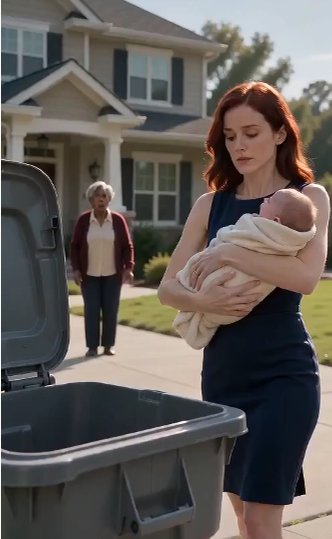
My mother saw the baby before she saw the woman.
She had just stepped through the side gate when a cry came from behind the detached garage.
Not a playful cry.
Not the irritated fussing babies make when they're hungry.
A terrified, breathless scream.
Mom dropped the grocery bag in her hand.
“LILY?”
She ran across the yard.
Then stopped.
A woman was standing beside our large wheeled trash bin.
The lid was open.
One hand gripped the bin.
The other held a crying baby against her chest.
From where Mom stood, all she could see was a pink blanket.
Tiny legs.
A white sock.
And dark hair.
Exactly what my eight-month-old daughter Lily had been wearing that morning.
Mom's face changed.
“WHAT THE HELL ARE YOU DOING?!”
The woman spun around.
“Wait—”
Mom didn't wait.
She sprinted across the grass.
“GET AWAY FROM THAT BIN!”
“Ma'am, stop!”
Mom reached her.
Grabbed the baby.
The woman tightened her arms.
“NO!”
“LET HER GO!”
The baby screamed.
Mom pulled harder.
The woman finally released her.
Then Mom slapped her.
SMACK.
The woman's head snapped sideways.
“What is WRONG with you?!”
Mom clutched the crying baby against her chest.
“STAY AWAY FROM MY GRANDDAUGHTER!”
The woman stared at her.
“YOUR granddaughter?”
“Don't come any closer!”
“GIVE HER BACK!”
She stepped forward.
Mom backed away.
“HELP!”
The back door of the house flew open.
I ran outside.
“Mom?”
She turned.
“DAVID!”
I saw the woman.
The open trash bin.
The baby in my mother's arms.
And my stomach dropped.
“What happened?”
“She was standing beside the trash with Lily!”
The woman pointed toward Mom.
“She took my baby!”
“What?”
“GIVE HER BACK!”
I moved between them.
“Everybody stop!”
“David, call the police!”
“They're already coming!” the woman shouted.
Mom looked down.
The baby had turned her face upward.
For the first time, my mother got a clear look at her.
She froze.
The crying continued.
But Mom didn't move.
Her eyes went to the baby's cheeks.
Then her nose.
Then the tiny gold stud in one ear.
My daughter didn't have pierced ears.
Mom's mouth opened.
She looked at me.
Then down again.
“Wait…”
Her voice almost disappeared.
“She’s not my granddaughter.”
The woman behind me began crying.
“I've been trying to tell you that!”
Mom stared at the child in her arms.
I stared at Mom.
Then—
blue lights flashed across the side of our house.
Red followed.
A siren chirped once.
Two police cruisers turned into our driveway.
The woman pointed toward the gate.
“That's them!”
Mom looked terrified.
“David…”
I had no idea what had happened.
But I knew one thing.
My mother had just taken a stranger's baby.
And somewhere inside my house—
my actual daughter was supposed to be sleeping.
My name is David Lawson.
I was thirty-seven when this happened.
My wife, Hannah, and I lived in a quiet suburb outside Columbus, Ohio, with our eight-month-old daughter Lily.
Lily was our first child.
Which meant we were still in that stage of parenthood where everything felt dangerous.
Blankets.
Stairs.
Food sizes.
Car-seat straps.
Bath water.
Electrical outlets.
Sleeping positions.
Random pieces of lint on the carpet.
Before Lily was born, I'd thought babies were fragile in an abstract way.
After she was born, I became convinced the entire world had been specifically designed to contain objects she could choke on.
Hannah was calmer.
Mostly.
My mother was not.
Her name was Margaret Lawson.
Everyone called her Maggie.
She was sixty-four, retired from an elementary school office, widowed, energetic, loving, and completely incapable of reacting to anything involving Lily at less than maximum intensity.
If Lily sneezed twice, Mom wanted to know whether we'd called the pediatrician.
If she bumped her forehead on a toy, Mom wanted ice.
If a dog barked too close to the stroller, Mom stared at the owner as if preparing a lawsuit.
We teased her about it.
She knew we teased her.
She didn't care.
“That's my granddaughter,” she'd say.
As if those three words were a legal explanation for everything.
Usually, her protectiveness was harmless.
That Saturday afternoon, it wasn't.
Hannah was working.
She was a respiratory therapist at a children's hospital and occasionally worked weekend shifts.
I was home with Lily.
My mother planned to stop by around three.
Nothing unusual.
At 2:20, Lily finished a bottle.
At 2:40, she fell asleep.
I carried her upstairs and placed her in the crib.
Checked the monitor.
Closed the door.
Then went downstairs.
Our backyard was enclosed by a six-foot privacy fence.
There was a detached two-car garage at the end of the driveway.
Trash and recycling bins sat beside it, partially hidden behind a short wooden screen.
Beyond our rear fence was another neighborhood street.
A narrow pedestrian path ran between several properties and connected the two blocks.
Kids used it.
Dog walkers used it.
Joggers.
Parents pushing strollers.
I'd never thought much about it.
Until that afternoon.
At 2:51, I heard a car door outside.
I assumed Mom had arrived early.
She hadn't.
The car belonged to a young woman named Elena Ramirez.
I didn't know her then.
Elena was twenty-nine.
She lived about three blocks away with her husband, Marco, and their eleven-month-old daughter, Sofia.
That afternoon, Elena had been walking Sofia in a stroller.
She was also carrying a small bag of household trash.
That detail would create almost the entire misunderstanding.
A public trash container near the pedestrian path had been removed temporarily during maintenance.
Elena had a leaking bag containing a used diaper and an empty baby-food pouch.
She didn't want to carry it all the way home.
She saw our large trash bin beside the garage.
The driveway gate was partly open because I'd brought the bins back from collection that morning and hadn't latched it fully.
Elena made a decision that was technically rude but otherwise ordinary.
She walked several steps onto our property intending to put the small trash bag into our bin.
She parked Sofia's stroller beside the garage.
Then Sofia started crying.
Elena picked her up.
With the baby in one arm, she opened our trash bin with the other.
That's the exact moment my mother entered the yard.
Mom didn't see the stroller.
It was on the far side of the garage.
She didn't see the small tied trash bag in Elena's hand.
The bin blocked it.
She didn't know another mother had walked into the yard.
She saw only an unfamiliar woman holding what looked like Lily beside an open trash container.
And because Lily had been wearing a pink blanket earlier—
Mom's brain completed the picture.
Not carefully.
Instantly.
Baby.
Pink blanket.
Our yard.
Open trash bin.
Strange woman.
Danger.
By the time Elena said:
“Ma'am, stop!”
Mom was already running.
The officers separated us immediately.
One spoke with Elena.
One spoke with Mom.
I stood in the middle trying to understand why any of this was happening.
The first officer asked:
“Whose child is this?”
Elena pointed.
“Mine.”
Mom still held Sofia.
Her hands had begun shaking.
“I thought…”
The officer said:
“Ma'am, please hand the child to her mother.”
Mom did.
Immediately.
Elena took Sofia and pressed the baby against her shoulder.
“It's okay.”
She was crying almost as hard as her daughter.
Mom whispered:
“I'm sorry.”
Elena didn't respond.
I asked:
“Where's Lily?”
Mom looked at me.
“I thought that was Lily.”
“No. Where is Lily?”
“I don't know!”
Panic hit me.
For one horrible second, Mom's certainty infected me.
What if Lily wasn't upstairs?
What if something had happened before Mom arrived?
I ran toward the house.
The officer called after me.
“Sir!”
“My daughter's inside!”
I opened the back door.
Ran through the kitchen.
Up the stairs.
I could hear the white-noise machine from the hallway.
I pushed open the nursery door.
Lily was asleep.
On her back.
One hand beside her head.
Completely unaware that three adults and two police officers were outside having the worst afternoon of their lives because of her.
I touched her chest.
Breathing.
Warm.
Fine.
I sat on the floor beside the crib.
For maybe ten seconds, my legs wouldn't work.
Then I started laughing.
Not because anything was funny.
Adrenaline does strange things.
Lily opened her eyes.
Looked at me.
And immediately began crying.
“Yeah,” I whispered.
“Fair.”
I carried her downstairs.
When Mom saw her, she covered her mouth.
“Oh my God.”
Lily reached toward her.
Mom didn't move.
Usually, Mom would've taken her instantly.
This time she stepped backward.
“No.”
“Mom?”
“I can't.”
She looked toward Elena.
Elena stood near the driveway holding Sofia.
Two babies.
Both wearing pink.
Both dark-haired.
Both about the same size from a distance.
Up close, they looked nothing alike.
Mom started crying.
“I thought…”
I said:
“I know.”
“No, David.”
She shook her head.
“I hit her.”
The officer heard.
“Yes, ma'am. We're going to discuss that.”
Mom nodded.
No argument.
No:
But I was protecting my granddaughter.
No justification.
She simply said:
“I understand.”
That was the beginning of the real story.
Because once everyone was safe, we had to separate what Mom feared had happened—
from what had actually happened.
Elena had called 911 before Mom arrived.
That surprised us.
The police weren't responding to the slap.
They were already coming.
Why?
Because Elena had been looking for someone.
Her older brother.
His name was Gabriel.
He was thirty-two and lived with their mother after experiencing a period of significant personal instability.
I didn't know the details then.
They weren't really my business.
What mattered was that Gabriel had left the family home earlier that afternoon after an argument.
He'd taken Elena's diaper bag by mistake because it looked similar to his backpack.
The bag contained her phone charger, house keys, and some of Sofia's supplies.
Elena followed the route she thought he'd taken.
A neighbor reported seeing him near our block.
Elena called police because she was worried about him and wanted assistance locating him safely.
That's why the cruisers were already approaching our neighborhood when Mom grabbed Sofia.
The timing made everything look even more dramatic.
Police lights arrived seconds after Mom realized she'd taken the wrong baby.
But they weren't racing toward our house because somebody had witnessed an attempted kidnapping.
There had been no kidnapping.
There had been a misunderstanding—
followed by an assault.
Mom's slap.
That distinction mattered.
One officer asked whether we had cameras.
We did.
Doorbell camera.
Driveway camera.
Rear garage camera.
I suddenly realized the garage camera probably captured everything.
The officer asked if I could retrieve the footage.
“Yes.”
I opened the app.
The video began several minutes before Mom arrived.
Elena entered through the partly open gate.
Stroller.
Baby.
Small trash bag.
She parked the stroller.
Lifted Sofia.
Opened our bin.
Then Mom entered.
She stopped.
Dropped her grocery bag.
Ran.
The audio was clear.
“WHAT THE HELL ARE YOU DOING?!”
Elena:
“Wait—”
Mom:
“GET AWAY FROM THAT BIN!”
Elena:
“Ma'am, stop!”
Then the struggle.
Mom pulled Sofia away.
Elena shouted:
“THAT'S MY DAUGHTER!”
Mom slapped her.
The sound was awful.
Then:
“STAY AWAY FROM MY GRANDDAUGHTER!”
Elena:
“YOUR granddaughter?”
Even watching from my phone, I could see the confusion on Elena's face.
She hadn't understood what Mom thought was happening.
Mom hadn't understood what Elena was saying.
Two people were responding to completely different realities.
Then I came outside.
Mom told me Elena had been standing beside the trash with Lily.
Elena demanded Sofia back.
Then Mom looked down.
“Wait… she’s not my granddaughter.”
It was all there.
No hidden plot.
No mysterious woman.
No attempted disposal of a baby.
No child abduction.
A mother trying to throw away a diaper.
A grandmother making the worst assumption imaginable.
The officer asked Elena whether she wanted medical attention.
Her cheek was red.
She declined an ambulance but agreed to be evaluated later if needed.
Then he asked whether she wanted to make a report regarding the slap.
“Yes.”
Mom closed her eyes.
I felt an instinct to defend her.
It lasted about two seconds.
Then I looked at Elena.
She was holding Sofia.
Her hands were still trembling.
My mother had run at her.
Taken her child.
Hit her.
Elena had every right to want the incident documented.
I said nothing.
Mom didn't argue either.
She gave her information.
Answered questions.
The officer asked:
“Why did you believe the child was your granddaughter?”
Mom pointed toward Lily.
“Pink blanket. Dark hair. Same size. I saw the trash bin open.”
“Did you see the woman putting the child into the bin?”
Mom hesitated.
“No.”
“Did you see her attempting to?”
“No.”
“What did you actually see?”
That question changed Mom's expression.
She looked toward Elena.
Then toward the trash bin.
“A woman holding a baby beside an open bin.”
The officer nodded.
“Okay.”
Mom whispered:
“That's all.”
Exactly.
That's all she'd actually seen.
Everything else had happened in her head.
Elena looked at me.
“Why was she screaming that I had her granddaughter?”
“Because my daughter was inside.”
“That doesn't make sense.”
“I know.”
She stared at Lily.
Then at Sofia.
The babies were both calmer now.
Elena said:
“They don't even look alike.”
Mom heard.
“I only saw the blanket.”
Elena turned.
“You didn't even look at her face before you took her from me.”
Mom had no answer.
“You hit me.”
“I know.”
“I kept telling you she was mine.”
“I know.”
“You didn't listen.”
Mom's voice broke.
“I know.”
Elena looked furious.
And she deserved to.
Then she said:
“You scared my baby.”
Mom began crying again.
That was the sentence that hurt her most.
Not:
You assaulted me.
Not:
You were wrong.
You scared my baby.
Because Mom had acted under the belief she was protecting a child.
Instead, she'd terrified one.
The police remained professional.
Nobody put Mom in handcuffs in the driveway for dramatic effect.
Nobody screamed.
Nobody made instant legal declarations.
They documented.
Asked questions.
Reviewed footage.
Collected information.
The situation would be handled through the appropriate process.
Elena's original call regarding her brother was separately addressed.
Another officer located Gabriel later that afternoon several streets away.
He was safe.
The diaper bag was recovered.
That part ended without further incident.
The conflict at our house was different.
Mom had to face consequences for her own actions.
Her intention mattered as context.
It didn't erase what she did.
That was difficult for me to accept at first.
After the officers left, Mom sat at our kitchen table.
She didn't touch her coffee.
Hannah came home early after I called her.
I told her the basic story before she arrived.
She still looked stunned when she walked into the kitchen.
“Your mom did what?”
Mom answered herself.
“I took another woman's baby.”
Hannah stared.
“And slapped her.”
Mom nodded.
“Why?”
“I thought she had Lily.”
“But Lily was upstairs.”
“I didn't know that.”
“Why wouldn't Lily be upstairs?”
Mom started crying.
“I don't know.”
Hannah sat down.
For a while, nobody spoke.
Then Hannah asked:
“What exactly did you think the woman was doing?”
Mom looked ashamed.
“I saw the trash bin.”
“That isn't an answer.”
“I thought…”
She couldn't finish.
Hannah did.
“You thought she was going to put a baby in the trash?”
Mom covered her face.
“Yes.”
The kitchen went silent.
Hannah looked at me.
I looked away.
When you say an assumption aloud after the adrenaline disappears, sometimes you hear how much distance existed between evidence and fear.
Mom finally said:
“I thought somebody had taken Lily.”
“From upstairs?” Hannah asked.
“I didn't know she was upstairs.”
“You came here to visit her.”
“I know.”
“Did you think David left her alone in the yard?”
“No.”
“Then how did you get from seeing a woman holding a baby to believing she had our daughter?”
Mom shook her head.
“I don't know.”
Hannah wasn't being cruel.
She was trying to understand.
So was I.
Mom said:
“I heard crying. I saw pink. I saw the bin. I panicked.”
That was probably the most accurate explanation.
Panic had connected unrelated facts.
Then converted the story it created into certainty.
The next morning, Mom called me at seven.
“I want to apologize to her.”
“Elena?”
“Yes.”
“I don't think you should just go to her house.”
“I wasn't going to.”
Good.
“What do you want to do?”
“Write a letter.”
“That might be better.”
“Will you give it to her?”
“If she wants it.”
Mom was quiet.
Then:
“David?”
“Yeah?”
“I keep hearing the baby cry.”
“Sofia?”
“Yes.”
I didn't know what to say.
Mom continued.
“When I grabbed her, she looked at me like she was terrified.”
“She's a baby.”
“I know.”
“I think you need to give Elena space.”
“I know.”
“And maybe talk to someone.”
Mom didn't answer immediately.
“You think I'm crazy?”
“No.”
“Then why?”
“Because you went from zero to emergency without checking anything.”
She inhaled.
“That sounds terrible.”
“It was terrible.”
I hated saying it.
But softening it wouldn't help.
Mom whispered:
“I know.”
Elena agreed to receive the letter.
Nothing more.
No meeting.
No phone call.
Mom wrote four pages.
I told her four pages might be too much.
She rewrote it.
One page.
She didn't explain her intentions until the final paragraph.
The beginning was simple.
I took your daughter from your arms and struck you. You told me she was your child, and I did not listen. I frightened both you and Sofia. I am sorry.
Good.
Then:
I believed I was protecting my granddaughter, but what I believed does not change what I did to you.
Better.
She ended:
You do not owe me a response or forgiveness.
I gave the letter to Elena through an arrangement we made by text.
She didn't respond.
Mom asked every day for a week whether she'd said anything.
“No.”
Eventually I told Mom:
“You said she didn't owe you a response.”
“I know.”
“Then you have to mean it.”
She nodded.
That was hard for her.
Apologies often contain a hidden desire.
Please make me feel better about what I did.
A real apology can't demand that.
Three weeks later, Elena texted me.
Is your mother still coming to your house?
I answered honestly.
Yes, but less often right now. Why?
A minute later:
I want to talk to her. Public place. You there too.
I showed Mom.
She stared at the message.
“Does she want me to?”
“Yes.”
Mom looked terrified.
That was probably appropriate.
We met at a coffee shop.
Elena brought Marco but left Sofia with her mother.
I went with Mom.
Mom didn't try to hug Elena.
Didn't reach for her.
Didn't cry immediately.
She said:
“Thank you for meeting me.”
Elena nodded.
Then:
“I read your letter.”
“Okay.”
“I was angry.”
“You should've been.”
“I still am.”
Mom nodded.
“I understand.”
Elena stared at her.
“No, I don't think you do.”
Mom remained quiet.
So Elena explained.
She told us what the incident had felt like from her side.
She was carrying her crying daughter.
A stranger suddenly charged at her screaming.
She tried to explain.
The stranger grabbed Sofia.
Elena resisted because, from her perspective, someone was trying to take her baby.
Then that stranger hit her.
For several seconds, Elena genuinely believed Mom might run away with Sofia.
“I didn't know you.”
Mom whispered:
“I know.”
“You knew what you thought you were doing. I didn't.”
Mom's eyes filled.
Elena continued.
“You thought you were saving a baby.”
“Yes.”
“I thought I was losing mine.”
Mom cried.
Quietly.
She didn't interrupt.
Then Elena asked:
“Why didn't you listen?”
Mom shook her head.
“I don't know.”
“You heard me.”
“Yes.”
“I said she was mine.”
“Yes.”
“More than once.”
“Yes.”
“And you still thought you knew better.”
Mom nodded.
That was the heart of it.
Not just the mistake.
The certainty.
Mom had received contradictory information directly from the child's mother and dismissed it because it didn't fit the emergency she'd already constructed.
Elena said:
“If David hadn't come outside, what would you have done?”
Mom looked horrified.
“I don't know.”
“Would you have taken Sofia into the house?”
Mom couldn't answer.
“Would you have called police while holding my daughter?”
“Probably.”
“Would you have let me follow you?”
“I don't know.”
Elena looked away.
“That scares me.”
It scared all of us.
Marco spoke for the first time.
“My wife shouldn't have gone into your yard to use your trash.”
Elena looked at him.
“I know.”
He continued.
“That was wrong. But it doesn't make what happened reasonable.”
Mom nodded.
“No.”
That small admission mattered too.
Reality didn't require Elena to be flawless.
She had entered our property without asking.
She shouldn't have.
That was a boundary issue.
It was nowhere near equivalent to taking her child and striking her.
Two wrong actions can exist in the same story without becoming equal.
Mom understood that.
So did Elena.
Then Elena surprised us.
She pulled out her phone.
“I want to show you something.”
A photograph.
Sofia sitting on a blanket.
Smiling.
Big brown eyes.
Tiny gold earrings.
Mom looked.
“She’s beautiful.”
Elena nodded.
“That was two days before.”
Mom started crying again.
“I am so sorry.”
“I know.”
Elena locked the phone.
“I don't forgive you yet.”
Mom nodded.
“Okay.”
“But I believe your apology.”
Mom looked up.
That was all Elena gave her.
It was more than Mom expected.
My mother's behavior changed after that day.
Not dramatically overnight.
But noticeably.
She began asking questions before reacting.
At first, almost comically.
If Lily cried in another room, Mom would stand and say:
“I'm going to check.”
Instead of sprinting.
If someone unfamiliar approached Lily at a family event, Mom looked at us before intervening.
Once, a woman at the grocery store touched Lily's sock.
Mom's entire body tensed.
Then she stopped.
Looked at me.
I said:
“It's fine.”
Mom exhaled.
Progress.
She also started seeing a counselor.
Not because we believed she had some hidden violent personality.
Because she wanted to understand why fear had overridden everything else so completely.
Part of it went back years.
My younger sister had disappeared in a department store when she was four.
Only for twelve minutes.
They found her with an employee.
But Mom had spent those twelve minutes believing her daughter was gone.
Then, when I was eleven, a neighborhood child had been seriously injured in an accident.
Mom became the parent who checked everything twice.
Doors.
Seat belts.
Bike helmets.
Pool gates.
After my father died, that vigilance intensified.
Then Lily arrived.
First granddaughter.
Mom adored her.
Love mixed with old fear.
Usually that produced extra phone calls and unnecessary warnings.
That afternoon, the right visual trigger turned it into action.
Again—
explanation.
Not excuse.
Mom understood that distinction better than anyone by then.
There was another consequence I hadn't expected.
I became angry with myself.
Why?
Because the gate was open.
Because Mom didn't know Lily was sleeping upstairs.
Because I hadn't told her.
Because our trash bin was accessible.
Ridiculous things.
Hannah noticed.
One night she said:
“You're doing the same thing your mom does.”
“What?”
“Trying to create a version where you could've controlled everything.”
“I left the gate open.”
“So?”
“If it had been closed, Elena wouldn't have come in.”
“Maybe.”
“And none of this happens.”
“Maybe.”
I stared at her.
She continued.
“But leaving a gate partly open didn't make your mother slap someone.”
I knew.
Still.
“If I'd texted Mom that Lily was sleeping—”
“David.”
“What?”
“You don't send your mother a live status update every ten minutes.”
“I could've—”
“No.”
She took my hand.
“We fix what actually needs fixing.”
So we did.
The gate latch was repaired.
The bins were moved fully inside the fenced area.
A small sign went up near the side entrance.
But we didn't turn our home into a fortress because one strange chain of circumstances had collided in our backyard.
Elena and I communicated occasionally after that.
Mostly practical.
Updates about the report.
Questions.
Eventually those stopped.
Then, nearly six months later, something unexpected happened.
Hannah and I took Lily to a neighborhood fall festival.
Pumpkins.
Food trucks.
Kids in costumes.
I was carrying Lily when Hannah touched my arm.
“David.”
I followed her eyes.
Elena stood near a picnic table.
Marco beside her.
Sofia in a stroller.
Mom was with us.
She saw Elena too.
Immediately, Mom stopped.
“I can leave.”
Hannah said:
“You don't need to run.”
“I don't want her uncomfortable.”
Before we decided anything, Elena noticed us.
For a moment, nobody moved.
Then Elena raised one hand.
A small wave.
Mom looked at me.
“Do I wave?”
I almost laughed.
“If you want.”
Mom waved.
Elena walked toward us.
Mom stayed exactly where she was.
No approaching Sofia.
No dramatic reconciliation.
Elena looked at Lily.
“So that's the famous granddaughter.”
I laughed awkwardly.
“That's her.”
Mom said:
“Yes.”
Elena looked between Lily and Sofia.
Then smiled slightly.
“They really don't look alike.”
Mom closed her eyes.
“I know.”
For half a second, I worried the comment would hurt.
Then Elena laughed.
Mom did too.
Not because what happened was funny.
Because sometimes enough time passes that one detail becomes absurd without making the larger event acceptable.
Mom said:
“I only saw the pink blanket.”
“I know.”
Elena looked at Sofia.
“She doesn't even use that blanket anymore.”
“Neither does Lily.”
“Probably for the best.”
Another tiny laugh.
Then the babies looked at each other.
Sofia reached toward Lily.
Lily stared at her.
Mom kept her hands at her sides.
That detail mattered to me.
A year passed.
Then another.
Mom remained involved in Lily's life.
Protective.
Still Mom.
But different.
Whenever she told the story herself, she never described it as:
“The day I almost saved the wrong baby.”
She called it:
“The day I let fear tell me a story before I knew the facts.”
I liked that better.
Because that's what happened.
There is one part people always misunderstand when I tell them about it.
They focus on the trash bin.
Of course they do.
It's the most shocking image.
Woman.
Crying baby.
Open trash.
Grandmother running.
It creates an immediate narrative.
Exactly the narrative Mom created.
People hear those details and say:
“I would've done the same thing.”
Maybe.
But that's the dangerous part.
Because the image feels more complete than it is.
What was actually happening?
Elena had a dirty diaper in a bag.
She wanted to throw it away.
Sofia cried.
Elena picked her up.
That's it.
The trash bin had nothing to do with the baby.
But place two unrelated objects close together—
baby and trash—
and the human mind desperately wants a connection.
Mom supplied one.
Instantly.
Then acted on it.
Years later, I showed Mom the security video again.
She asked.
I wouldn't have suggested it.
We sat at my kitchen table.
I opened the old file.
There was Elena.
Stroller.
Trash bag.
Sofia.
Mom watched carefully.
Elena lifted the bag.
Opened the bin.
Then Sofia cried.
Elena set the bag down.
Picked up her daughter.
Mom paused the video.
“There.”
“What?”
“I didn't see the bag.”
“No.”
“I saw her hand near the trash.”
“Yeah.”
Mom resumed.
Then video-Mom entered the yard.
Dropped groceries.
Ran.
Current Mom whispered:
“Stop.”
I paused.
She pointed at the screen.
“Look at her.”
“Elena?”
“Yes.”
Elena's face was visible.
Confused.
Not secretive.
Not fleeing.
Just confused about why a stranger was sprinting toward her.
Mom said:
“If I'd looked at her face for two seconds…”
Maybe.
Maybe not.
But I understood.
She resumed.
Then came the slap.
Mom flinched.
“Turn it off.”
I did.
For a moment, she stared at the blank phone.
Then:
“I was so sure.”
“I know.”
“That scares me more than being wrong.”
I understood exactly what she meant.
Being wrong is ordinary.
Being completely certain while wrong is more dangerous.
Lily and Sofia ended up attending the same preschool.
Of course they did.
Because apparently life has a strange sense of humor.
When we discovered it, I texted Elena:
You are not going to believe this.
She replied with a photo of the class list.
Already saw it.
Then:
Tell your mom Sofia is definitely mine at pickup.
I laughed so hard Hannah came into the room.
“What?”
I showed her.
She covered her mouth.
“Is it okay to laugh?”
“I think Elena just gave us permission.”
Mom didn't find it funny initially.
Then Elena told her the joke directly.
After that, she laughed too.
Carefully.
The girls became friends.
Not best friends.
No destiny.
No forced storybook ending.
Just two children who liked the same playground and occasionally argued over plastic dinosaurs.
Their relationship had nothing to do with what happened when they were babies.
We kept it that way.
They didn't need to inherit adult history.
At one birthday party, Sofia and Lily ran through our backyard together.
Mom was sitting beside me.
She watched them.
Then looked toward the garage.
The trash bins had been relocated years earlier.
“You know,” she said, “I still hate that corner.”
“I know.”
“Do you?”
“Not really.”
She smiled.
“Good.”
Then Sofia fell.
Scraped her knee.
Started crying.
Mom stood instantly.
Then stopped herself.
Elena was closer.
Elena picked Sofia up.
Mom remained where she was.
Elena looked over.
For one second, their eyes met.
Then Elena smiled.
Mom smiled back.
I don't think anyone else noticed.
I did.
That tiny moment told me more about Mom's growth than any apology.
Years earlier, a crying baby triggered panic.
Now she could see a crying child and recognize:
Her mother is there.
She has it.
I don't need to take control.
Sometimes change is simply learning when not to move.
My mother and Elena never became close friends.
That would've been too neat.
They became friendly.
There is a difference.
They spoke at school events.
Exchanged Christmas greetings.
Mom once brought soup when Elena had surgery, but she left it with me to deliver rather than appearing at her door.
Elena later sent Mom a thank-you note.
Boundaries remained.
Respect grew.
That was enough.
The slap had consequences beyond embarrassment.
Mom had to participate in the process that followed the report.
I won't dramatize the outcome into something it wasn't.
There was no spectacular courtroom confrontation.
No judge delivering a viral speech.
No instant ruin.
The available evidence was clear, including the footage.
Mom cooperated.
Elena's wishes mattered within the process where appropriate.
The incident was handled through the relevant legal channels.
There were costs.
Stress.
Time.
Accountability.
Mom didn't enjoy any of it.
She wasn't supposed to.
But she never blamed Elena for reporting what happened.
Not once.
When a relative said:
“She could've just let it go,”
Mom became angry.
“No.”
The relative looked surprised.
Mom continued:
“I hit her and took her child out of her arms.”
“But you thought—”
“I know what I thought.”
She pointed toward herself.
“That was my mistake. Not hers.”
I was proud of Mom in that moment.
Not for what she'd done.
For refusing to turn accountability into another grievance.
That relative tried again.
“But your intentions were good.”
Mom answered:
“Good intentions don't give me permission to ignore someone telling me that's her baby.”
Silence.
Then Mom added:
“If I want people to believe my apology, I have to stop putting a ‘but’ after it.”
That became another family phrase.
No “but” apologies.
I'm sorry, but I was scared.
I'm sorry, but you were in my yard.
I'm sorry, but the situation looked bad.
Everything after “but” quietly asks the injured person to share responsibility for what you did.
Mom stopped doing that.
I learned something from Elena too.
Months after everything, I asked why she'd agreed to meet Mom.
She thought about it.
“I wanted her to see me.”
“What do you mean?”
“She only saw a threat that day.”
I nodded.
“I wanted her to sit across from the person she hit and understand I was just somebody's mom.”
That sentence stayed with me.
Mom had reduced Elena to a role in an imagined emergency.
Strange woman.
Possible danger.
Potential kidnapper.
Elena wanted to become a person again.
Mother.
Wife.
Daughter.
Woman carrying a dirty diaper and a crying baby.
Ordinary.
That's what fear can erase first.
Ordinariness.
The older I get, the more I think that afternoon was really about stories.
Mom saw a story.
Elena experienced another.
The police arrived with no story and started collecting facts.
The camera had no story at all.
It simply showed events.
Elena enters.
Stroller visible.
Bag visible.
Baby cries.
Baby lifted.
Bin opens.
Margaret enters.
Margaret runs.
Argument.
Baby taken.
Slap.
David arrives.
Mistake recognized.
Facts.
Then humans had to decide what they meant.
That's where responsibility begins.
If the camera hadn't existed, the basic truth still would've been recoverable.
Elena had her stroller.
Baby supplies.
Photographs.
Witnesses along her walking route.
Her husband.
Her 911 call.
I had Lily upstairs.
Mom herself admitted the mistake immediately after seeing Sofia's face.
The camera didn't magically create the truth.
It simply removed room for people to reshape uncomfortable details later.
Mom couldn't tell herself she had gently taken Sofia.
The video showed the struggle.
She couldn't say Elena never told her.
Audio captured Elena repeatedly trying.
She couldn't minimize the slap.
It was there.
And Elena couldn't deny entering our property to use the trash bin.
That was there too.
Evidence was indifferent.
That's useful.
Years later, Mom told me she was grateful for the camera.
“Grateful?”
“Yes.”
“Why?”
“Because I would've remembered it differently.”
That surprised me.
“How?”
“I already did.”
She explained.
In the first few days after the incident, she remembered Elena moving toward the bin with Sofia.
The footage showed Elena was stationary with the baby in her arms.
Mom remembered Elena refusing to explain.
The footage showed Elena trying repeatedly.
Mom remembered grabbing Sofia after Elena lunged toward her.
The footage showed Mom initiating the confrontation.
Fear had edited the memory.
Not intentionally.
But effectively.
Watching the recording forced Mom to separate what she felt from what occurred.
That's difficult.
Necessary too.
Lily is older now.
She knows the funny version.
Grandma once mistook another baby for her.
She does not yet know every frightening detail.
Sofia knows roughly the same.
One afternoon the girls asked:
“How could Grandma Maggie think Sofia was Lily?”
Mom answered:
“You both had pink blankets.”
Sofia looked offended.
“I don't look like Lily.”
“No.”
“Not even a little.”
“No.”
Lily said:
“My hair is lighter.”
“Yes.”
Sofia pointed at her ears.
“I have earrings.”
“I know.”
Both girls stared at Mom.
Mom finally said:
“I made a very big mistake.”
Lily asked:
“Were you wearing your glasses?”
I had to leave the room because I was laughing too hard.
Mom shouted after me:
“THAT WAS NOT THE PROBLEM!”
Maybe not.
Still funny.
But when I think about the actual afternoon, I don't laugh.
I remember the first scream.
Mom running.
Elena shouting.
The open bin.
My mother's hand.
The slap.
Then the moment everything stopped.
Mom looking down.
Sofia looking up.
Two strangers seeing each other clearly for the first time.
Mom's face changing.
“Wait…”
Her eyes moving across the baby's features.
“She’s not my granddaughter.”
Then the police lights washing red and blue across our driveway.
If you cut the story there, it looks like the beginning of some enormous criminal mystery.
It wasn't.
The mystery had already been solved.
The baby belonged to the woman asking for her back.
The real question was how my mother had become so certain of something she had never actually seen.
That took much longer to answer.
The answer wasn't that Mom was evil.
It wasn't that she was stupid.
It wasn't that Elena behaved perfectly.
It wasn't even that one coincidence fooled everyone.
It was fear.
Plus incomplete information.
Plus love.
Plus old anxiety.
Plus a pink blanket.
Plus an open trash bin.
Plus a brain capable of turning all of those things into a complete narrative in less than a second.
Then action before verification.
That's what made it dangerous.
Mom once asked Elena directly:
“What should I have done?”
They were standing outside preschool.
Elena thought about it.
Then said:
“Ask me whose baby she is.”
Mom nodded.
“What if you lied?”
“Then call David.”
Mom nodded again.
“What if I thought the baby was in immediate danger?”
Elena looked at her.
“Then respond to what you actually see.”
Mom understood.
She had never seen Sofia being placed into the bin.
Never saw Elena hurting her.
Never saw a kidnapping.
She saw proximity and supplied intent.
That distinction became central to how Mom thought afterward.
Respond to what is happening.
Not the worst story you can imagine about what might happen next.
The last time the old trash bin came up, Mom and I were cleaning the garage.
She found the short wooden screen that used to hide the bins.
“You kept this?”
“Apparently.”
“Burn it.”
I laughed.
“It's wood.”
“Exactly.”
“Mom.”
“I hate that thing.”
“The screen did nothing.”
“Neither did the bin. I still hate that too.”
I leaned the wood against the wall.
She smiled.
Then:
“Do you know what the worst part was?”
“The slap?”
“Yes. But something else.”
“What?”
“When Elena said, ‘That's my daughter,’ I heard her.”
I stopped.
Mom continued.
“I actually heard the words.”
“Okay.”
“And I decided she was lying.”
I didn't know what to say.
“That bothers me more than the original mistake.”
“Why?”
“Because the first mistake was fast.”
She snapped her fingers.
“Pink blanket. Baby. Trash. Panic.”
Then she shook her head.
“But after she told me, I had new information.”
“And ignored it.”
“Yes.”
That was the moment Mom believed she had truly failed.
Not when fear created the wrong story.
When reality offered a correction and she refused it.
I think about that often.
We all make fast assumptions.
Most are harmless.
Someone doesn't text back—they're angry.
Someone looks at us strangely—they don't like us.
A child cries—someone hurt them.
A stranger is somewhere unexpected—they shouldn't be there.
The first interpretation arrives automatically.
Maybe we can't control that.
The second step is where responsibility lives.
What happens when new information appears?
Do we update?
Or defend the story because admitting uncertainty feels harder?
Mom defended hers for less than a minute.
That minute was enough.
Today, if you saw Mom with Lily, you'd still call her protective.
She checks seat belts.
Carries snacks.
Keeps sunscreen in her purse.
Asks whether Lily has a jacket even when it's seventy degrees outside.
Some things never change.
But panic no longer gets automatic authority.
That's the change that mattered.
And whenever someone in our family begins a sentence with:
“I KNOW what I saw—”
Mom sometimes interrupts.
“No.”
Everyone looks at her.
Then she says:
“Tell us what you actually saw.”
There's a difference.
She learned it beside an open trash bin while holding someone else's screaming child.
She saw a woman.
She saw a baby.
She saw pink.
She saw an open lid.
She saw enough to become frightened.
She did not see what she believed she saw.
And because she confused those two things, she frightened an innocent mother, terrified a baby, struck a stranger, and created consequences that lasted far longer than the sixty seconds in our backyard.
The security footage ends shortly after the police arrive.
One officer walks toward Elena.
Another toward Mom.
I'm standing beside the back door.
Lily is still upstairs.
Sofia is back in her mother's arms.
Mom stands alone near the grass.
The trash bin remains open behind her.
A small tied bag lies on the ground.
The bag that started everything.
Used diaper.
Empty baby-food pouch.
Nothing sinister.
Just trash.
Near the end of the recording, Mom turns toward the camera.
She doesn't know she's doing it.
Her face looks older than it did ten minutes earlier.
Then she looks toward Elena.
Even without clear audio, I know what she says.
“I'm sorry.”
It wasn't enough.
Not then.
An apology couldn't undo the slap.
Couldn't erase Sofia's fear.
Couldn't make Elena trust her.
But it was the first truthful thing Mom could offer once she finally understood the difference between the emergency she'd imagined—
and the mother who had actually been standing in front of her.
Years later, Mom would say the same thing differently.
“I thought love meant I should react faster.”
Then she'd shake her head.
“No. Sometimes love means being careful enough to make sure you're protecting the right person from a danger that's actually there.”
That's what she learned.
And that's why, when I remember that afternoon, the image that stays with me isn't the slap.
It isn't even the police lights.
It's my mother holding Sofia.
Looking down.
Seeing the tiny gold earring.
The unfamiliar eyes.
The face she'd never bothered to examine before deciding she knew everything.
Then hearing her own voice crack.
“Wait…”
A second look.
A horrible realization.
“She’s not my granddaughter.”
Behind her, Elena reached desperately for her child.
In front of her, I stood frozen.
And seconds later, red and blue light swept across the driveway.
But by then, the most important thing had already happened.
My mother had finally stopped reacting to the story in her head—
and looked at the baby in her arms.