HOA Karen Smashed the Farm’s Soil Monitor—Then the Owner Stepped Out
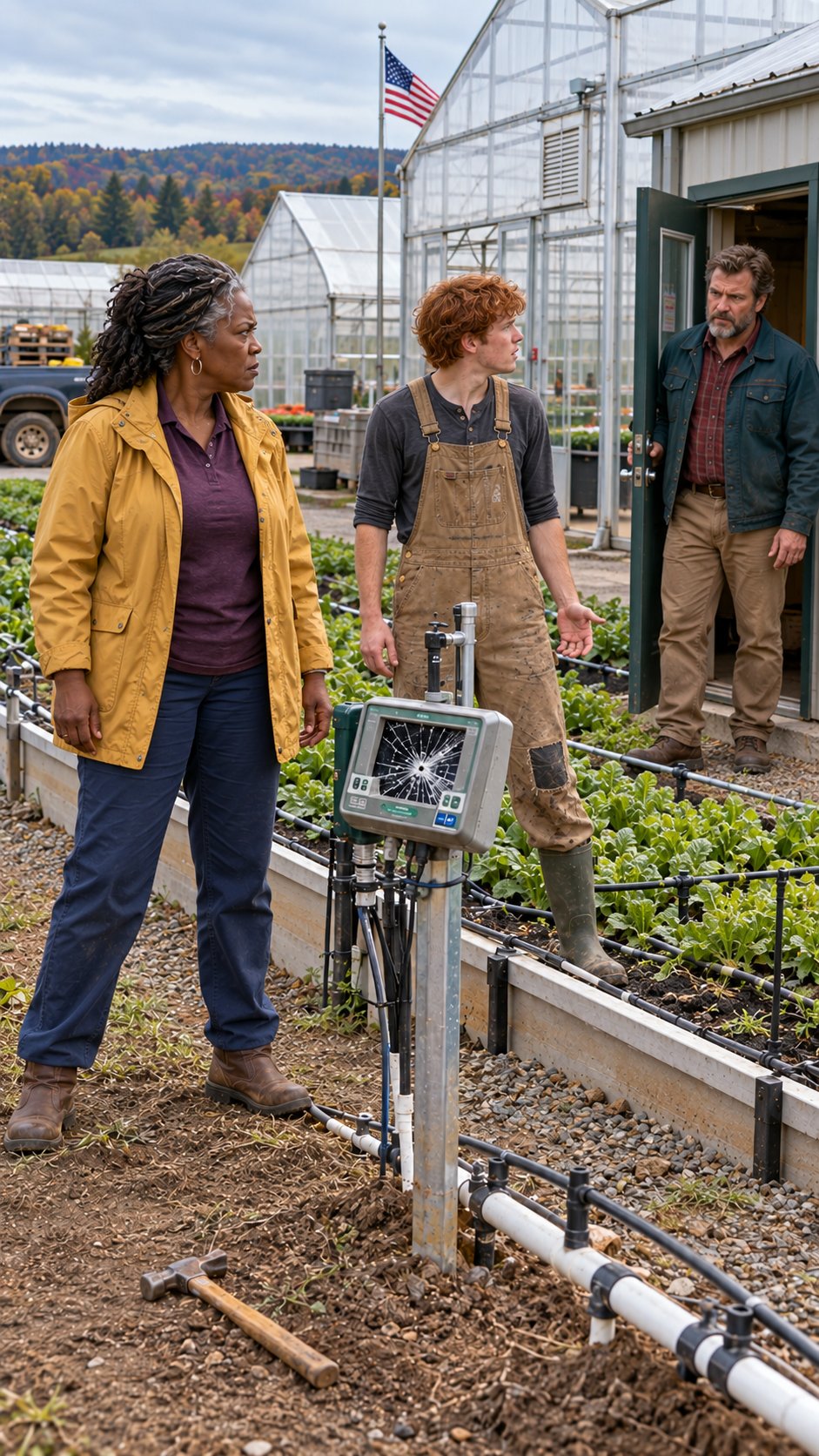
The hammer came down before I could reach her.
CRACK!
The plastic housing split.
The digital screen shattered into a spiderweb of black glass.
The small display that had shown 31% a second earlier went completely dark.
I stopped twenty feet away.
“What are you doing?”
Denise Carver raised the hammer again.
BANG!
The mounting bracket bent sideways.
A cable ripped loose from the weatherproof junction box beneath it.
Two women standing behind Denise laughed.
The third had her phone raised, recording.
Denise turned toward me with the hammer still in her hand.
“LET’S SEE YOU GROW ANYTHING NOW!”
I ran toward her.
“MY DAD JUST INSTALLED THAT!”
Denise looked at the shattered monitor.
Then at me.
She threw the hammer into the dirt.
“THEN TELL HIM TO BUY ANOTHER!”
I stared at her.
Behind me stood our greenhouse.
Nearly one hundred feet long.
Tomatoes, cucumbers, peppers, basil, and young melon vines filled its rows.
Beside it ran the irrigation system my father and I had spent most of August rebuilding.
I looked toward the small office attached to the packing shed.
“Dad?”
Denise laughed.
Actually laughed.
Then pointed toward the office door.
“YEAH—GO CRY TO HIM!”
The door swung open.
My father stepped outside.
Work boots.
Dusty jeans.
Dark green jacket with our farm logo stitched over the chest.
MILLER FAMILY FARM
EST. 1989
He didn't look at Denise first.
He looked at the monitor.
The broken screen.
The bent bracket.
The severed cable.
The hammer in the dirt.
Then he slowly lifted his eyes.
Denise's smile disappeared.
My father didn't shout.
He didn't threaten her.
He asked one question.
“Who gave you permission to come onto my farm?”
Nobody laughed after that.
My name is Owen Miller.
I was eighteen that fall.
People who drove past our property usually thought I was a farmhand.
Technically, I was.
I watered.
Harvested.
Loaded crates.
Cleaned equipment.
Repaired irrigation lines.
Pulled weeds.
Washed produce.
Delivered orders.
If something needed carrying, I was usually the person carrying it.
But the man who came through that office door wasn't my employer.
He was my father.
Grant Miller.
He was fifty-two.
And the forty-one acres surrounding us belonged to our family.
That fact was important.
Not because owning land made Dad powerful.
It didn't.
But because Denise Carver had spent nearly four months behaving as though our farm belonged to her neighborhood association.
It didn't.
That misunderstanding—or, eventually, refusal to accept the difference—was the reason a hammer ended up beside our greenhouse.
Our farm sat outside a growing town in northern Virginia.
Dad's parents had bought the original twenty-three acres in 1989.
Back then, the surrounding area was mostly pasture, woods, and a few old houses scattered along county roads.
My grandparents grew vegetables.
Dad expanded into greenhouse production.
Years later, he bought an adjoining eighteen-acre parcel when its owner retired.
By the time I was born, Miller Family Farm supplied produce to two independent grocery stores, several restaurants, a weekend farmers market, and a small community-supported agriculture program.
We weren't wealthy.
We weren't struggling every week either.
We were a working family farm.
Then development arrived.
A former cattle property east of us was sold.
Trees disappeared.
Roads appeared.
Then sidewalks.
Then streetlights.
Then eighty-seven expensive houses with stone fronts, decorative mailboxes, landscaped entrances, and a homeowners association called Stonebrook Ridge.
The development looked nice.
Most of the people living there were nice too.
That matters.
This wasn't a story about eighty-seven homeowners declaring war on a farm.
It was mostly about one board president who had difficulty understanding where her authority stopped.
Denise Carver moved into Stonebrook Ridge during its second year.
She was fifty-eight.
Former regional sales manager.
Organized.
Confident.
Extremely comfortable telling people what needed to happen.
Within eighteen months she joined the HOA board.
The following year she became president.
At first, we barely knew her.
Then the complaints started.
Mud on the county road after heavy rain.
Tractor noise before eight in the morning.
Delivery trucks.
A compost pile visible through trees in winter.
Greenhouse lights during seedling season.
A temporary produce sign near our driveway.
Most were minor issues.
Some were reasonable concerns.
Dad responded when appropriate.
We cleaned road mud.
Adjusted one delivery schedule.
Moved the produce sign farther from the intersection because sight distance mattered.
Dad wasn't anti-neighbor.
He always said:
“Farms don't exist in bubbles anymore.”
But he also understood something Denise seemed unable to accept.
Stonebrook Ridge's HOA covenants governed property inside Stonebrook Ridge.
Our farm wasn't inside Stonebrook Ridge.
The subdivision developer had bought land beside us.
Not from us.
Our deed predated the HOA by decades.
Our parcels weren't included in its declaration.
We didn't pay HOA dues.
We didn't vote in HOA elections.
We didn't use its private amenities.
And its architectural rules didn't control our greenhouse.
That should have ended most disagreements.
It didn't.
Denise began sending letters.
The first said our equipment storage area violated Stonebrook Ridge's exterior appearance standards.
Dad replied politely:
Miller Family Farm is not subject to the Stonebrook Ridge declaration.
The second complained about our greenhouse covering.
Same response.
Then came a letter demanding that we submit plans for a new wash station to the HOA architectural committee.
Dad didn't respond to that one.
A week later Denise appeared at our driveway.
I was seventeen then.
She handed me an envelope.
“Give this to the property owner.”
I looked at the name.
GRANT MILLER.
“That's my dad.”
She looked at my muddy boots.
“You work here?”
“Yes.”
“For your father?”
“Yes.”
She smiled in a way I didn't like.
“Then tell your father ignoring an HOA doesn't make it disappear.”
I gave Dad the envelope.
He read it.
Then put it in a folder.
The folder was already thick.
Dad had learned not to argue at the gate.
Document.
Save letters.
Photograph signs.
Keep dates.
Respond through proper channels.
It wasn't exciting.
It was effective.
The real conflict started when we installed the new irrigation-monitoring system.
That summer had been brutally dry.
Our greenhouse didn't depend entirely on rainfall, obviously, but irrigation efficiency mattered.
Dad had used simple timers and handheld moisture checks for years.
They worked.
The problem was that different greenhouse zones behaved differently.
A bed near an evaporative cooling wall could dry differently from a shaded row.
Young transplants needed different management from established tomato plants.
Container media behaved differently from in-ground beds.
So Dad decided to improve the system.
Not automate the entire farm.
Not let a computer “grow the crops.”
Just collect better information.
We installed soil and substrate moisture sensors in several representative locations.
Those sensors fed readings into a small controller and monitor mounted near the greenhouse service area.
The system let us compare moisture trends with irrigation cycles.
It could alert us when readings moved outside ranges we had set.
But the numbers weren't commands from God.
Dad still checked plants.
So did I.
We still looked at leaves.
Roots.
Weather.
Drainage.
Soil texture.
Plant stage.
Temperature.
A moisture sensor could be wrong.
A probe could lose contact.
A cable could fail.
The system was another tool.
A useful one.
That distinction would become important after Denise smashed the monitor and shouted that we wouldn't be able to grow anything.
We had grown vegetables before that monitor existed.
We could grow them after it broke.
What she destroyed was equipment.
Not knowledge.
The system still wasn't cheap.
Sensors.
Controller.
Weatherproof enclosure.
Wiring.
Installation.
Calibration.
Data interface.
Dad had saved for it.
I helped install conduit during summer break.
The monitor Denise later smashed had been replaced only eleven days earlier because the original display had developed moisture intrusion.
Dad had joked:
“If this one leaks, we're going back to sticking fingers in dirt.”
I said:
“Very scientific.”
“It fed you for eighteen years.”
Fair point.
Why did Denise care about a moisture monitor?
At first, she didn't.
She cared about the small post holding it.
Or claimed she did.
The monitor was mounted on a treated post beside the greenhouse, well inside our property.
From the nearest Stonebrook Ridge house, it was barely visible.
But Denise saw it while walking along a strip of common land near the subdivision boundary.
Three days after installation, Dad received an email.
Unapproved electronic equipment has been installed adjacent to Stonebrook Ridge common property. Remove or screen the equipment within ten days.
Dad showed me.
I laughed.
He didn't.
He printed the email.
Added it to the folder.
Then replied:
The equipment referenced is agricultural monitoring equipment located on Miller Family Farm property. Miller Family Farm is not subject to Stonebrook Ridge HOA architectural approval. No action will be taken in response to this request.
Denise answered twelve minutes later.
Your refusal is noted.
Dad looked at the screen.
“Good.”
“What?”
“She noted it.”
Then he went back to work.
The next week, three neighbors visited.
Not Denise.
Regular homeowners.
One was a retired teacher named Harold.
Another was a nurse named Priya.
The third, Megan, had two young children who loved our strawberries.
They weren't angry.
They were embarrassed.
Harold said:
“Denise told the board you're installing industrial monitoring equipment along our property line.”
Dad pointed.
“You mean that?”
Harold squinted.
“That's it?”
“Yes.”
The monitor was smaller than a shoebox.
Priya started laughing.
“I thought you were building a weather tower.”
“No.”
“What does it do?”
I explained.
Megan asked:
“Can it tell you when tomatoes need water?”
“Sort of.”
Dad corrected me immediately.
“It gives us information that helps us decide.”
That was Dad.
Never let technology get credit for farming.
They left satisfied.
Two days later Denise came herself.
She wasn't alone.
Three homeowners followed.
I recognized one.
Calvin Ross.
He had complained about our tractor once.
Another, Linda Shaw, lived near the subdivision entrance.
The third, Beth, I didn't know.
Denise walked straight toward the greenhouse.
Dad intercepted her.
“This is private property.”
“We're inspecting the installation.”
“No, you're not.”
“As HOA president—”
“This isn't HOA property.”
“We have concerns about equipment installed near our boundary.”
“Then you can send them in writing.”
“We already did.”
“And I answered.”
Denise looked past him.
“This equipment could affect neighboring properties.”
“How?”
“Wireless signals.”
I almost laughed.
Dad didn't.
“What effect are you concerned about?”
Denise hesitated.
“Interference.”
“With what?”
Another pause.
“Our community systems.”
Dad nodded.
“Send me the technical concern in writing and I'll have our installer review it.”
That was a clever answer.
Not because Dad believed the concern.
Because it required Denise to define it.
She never did.
Instead, the argument changed.
Now the monitor was visually unattractive.
Then it might reduce property values.
Then it was too close to a “shared boundary.”
Then it represented an expansion of commercial activity.
Every time Dad answered one objection, another appeared.
Eventually he stopped answering informal complaints.
“Written communication only,” he told Denise.
She hated that.
A month later, we learned why the farm had become such a focus.
Stonebrook Ridge wanted a second pedestrian access route.
Its existing walking trail ended near a wooded section of common property.
A direct extension toward the county greenway would've been convenient.
There was one problem.
The most direct route crossed the northeastern corner of our farm.
Not much.
Maybe a strip along the edge.
But it was ours.
The developer had apparently discussed acquiring an easement years earlier.
My grandfather refused.
Nothing happened.
Now Denise wanted the idea revived.
Dad wasn't completely opposed to discussing an easement.
That surprised me.
“You'd let them build a trail?”
“I'd listen.”
“Why?”
“Because being neighbors means sometimes listening.”
He had concerns.
Liability.
Farm equipment.
Biosecurity.
People wandering into production areas.
Dogs.
Trash.
Damage.
But he was willing to talk if Stonebrook Ridge approached formally.
Denise didn't begin formally.
She began by acting as if the easement should already exist.
She told homeowners our farm was “blocking community connectivity.”
Then she claimed agricultural activity near the boundary was incompatible with the neighborhood.
Then she suggested the farm might eventually expand industrial operations.
The moisture monitor became part of that narrative.
A tiny digital screen somehow became evidence of “industrialization.”
Dad finally attended an HOA board meeting after several homeowners asked him to.
I went too.
It was the first HOA meeting I'd ever seen.
I expected shouting.
Mostly there were folding chairs and people discussing mailbox paint.
Then Denise reached “community boundary concerns.”
She displayed a photograph of our greenhouse.
The monitor was circled in red.
I almost laughed.
Dad didn't.
Denise said:
“This type of commercial electronic infrastructure continues to appear without community review.”
Dad raised his hand.
A board member named Susan recognized him.
“Mr. Miller?”
Dad stood.
“My farm is not part of this HOA.”
Denise said:
“We understand your position.”
Dad replied:
“It isn't a position.”
Silence.
“It is a property fact.”
A few homeowners murmured.
Dad continued.
“If the association wants to discuss an easement, send a written proposal through counsel. If the association has a concern about an agricultural activity regulated by the county, identify that concern and we'll address it with the appropriate authority.”
Then he pointed at the photograph.
“But your architectural committee doesn't approve equipment on my land.”
Simple.
No speech.
No threat.
He sat.
That meeting made Denise furious.
I could tell.
But it also changed something among the homeowners.
Some had believed we were refusing reasonable HOA rules.
They hadn't realized the central issue was that the rules didn't apply to us.
Afterward, Harold approached Dad.
“She made it sound like you're inside some agricultural section of Stonebrook Ridge.”
“We're not.”
“I know that now.”
That sentence mattered.
For several weeks, things quieted down.
Harvest season began.
We were busy.
Tomatoes came fast.
Cucumbers faster.
Our greenhouse melons were almost ready.
The moisture system helped us spot one irrigation zone running longer than expected.
A valve was sticking.
We fixed it.
That probably saved water.
Nothing miraculous.
Just useful information.
Then someone began moving our boundary markers.
Not official survey monuments.
Small orange-topped stakes we'd placed as visual references after a survey.
One disappeared.
Another was found lying down.
Dad installed a trail camera facing the boundary.
The camera captured deer.
Raccoons.
A fox.
Two children retrieving a soccer ball.
Then Denise.
She walked onto our side.
Looked around.
Pulled one of the small stakes from the ground.
Carried it about fifteen feet.
Pushed it back in.
Dad watched the footage twice.
I expected him to explode.
He didn't.
He called the surveyor.
Then an attorney.
A licensed surveyor came the following week and re-marked the relevant line.
Dad also installed small signs:
PRIVATE FARM PROPERTY
ACTIVE AGRICULTURAL AREA
PLEASE REMAIN BEYOND MARKED BOUNDARY
Denise complained the signs were “hostile.”
Dad ignored her.
Then came the hammer.
It was a Tuesday afternoon in early October.
Warm for the season.
I had finished loading crates of peppers.
Dad was in the office reviewing invoices.
My mother, Elena, had gone into town.
I was walking back toward the greenhouse when I saw four people near the monitor.
Denise.
Calvin.
Linda.
Beth.
At first, I assumed another inspection performance.
Then I saw the hammer.
“Hey!”
Denise looked at me.
She placed one hand on the monitor.
“This has been ordered removed.”
“By who?”
“The association.”
“You can't remove our equipment.”
She turned toward the three neighbors.
“See? This is exactly the attitude.”
I started walking faster.
“Don't touch that.”
Denise raised the hammer.
I ran.
“STOP!”
CRACK!
The first blow shattered the screen.
I couldn't believe what I was seeing.
“WHAT ARE YOU DOING?”
She hit it again.
BANG!
The housing broke.
The cable pulled loose.
Calvin laughed.
Linda laughed too.
Beth kept recording.
Denise shouted:
“LET’S SEE YOU GROW ANYTHING NOW!”
That was when I reached them.
“MY DAD JUST INSTALLED THAT!”
She threw the hammer.
“THEN TELL HIM TO BUY ANOTHER!”
My hands were shaking.
I wanted to grab the broken monitor.
I didn't.
I looked toward the office.
“Dad?”
Denise laughed.
“YEAH—GO CRY TO HIM!”
Then the door opened.
Dad walked out.
He didn't hurry.
That's one of the things I remember most.
If he'd run, maybe Denise would've prepared herself.
Instead, he walked.
His eyes went to the damage.
Then the hammer.
Then Denise.
“Who gave you permission to come onto my farm?”
Denise straightened.
“The association has repeatedly notified you that this equipment is unauthorized.”
Dad looked at the monitor again.
“That's not what I asked.”
“We have authority over installations affecting Stonebrook Ridge.”
“Who gave you permission to enter my property?”
She pointed toward the boundary.
“This is disputed land.”
Dad's expression changed slightly.
“No.”
“Yes, it is.”
“No, Denise. It isn't.”
She looked toward Calvin.
He stopped smiling.
Dad continued.
“The county-recorded survey was completed three weeks ago. You're approximately sixty-two feet inside my parcel.”
Nobody spoke.
Denise recovered quickly.
“This equipment was installed to interfere with our proposed easement.”
Dad actually looked confused.
“The soil monitor?”
“Yes.”
“How?”
“You've been deliberately adding infrastructure along the route.”
Dad stared at her.
The proposed trail route wasn't even beside the monitor.
Not directly.
It was farther north.
He realized that.
So did I.
“Denise,” he said, “step away from the equipment.”
“It is already broken.”
“I can see that.”
“You should've removed it.”
“Step away.”
Beth lowered her phone.
Denise noticed.
“Keep recording.”
Beth didn't raise it again.
Dad looked at me.
“Owen.”
“Yeah?”
“Don't touch anything.”
I nodded.
“Go into the office and call the non-emergency number.”
Denise laughed again, but it sounded different now.
“You're calling the police over a garden gadget?”
Dad looked at the shattered monitor.
“No.”
He looked at her.
“I'm reporting someone entering private property and intentionally damaging equipment.”
Her smile vanished completely.
She stepped toward him.
“You want to turn this into a criminal matter?”
Dad didn't move.
“I want an accurate record of what happened.”
“Do you understand what that will do to relations with Stonebrook Ridge?”
Dad looked at the three neighbors.
Then at her.
“I don't think I did this.”
That shut her up.
I went inside.
Called.
Gave the address.
Explained there had been property damage.
Nobody was injured.
The person responsible was still present.
The dispatcher told us not to escalate and said a deputy would respond.
I returned outside.
Denise was on her phone.
Probably calling someone from the board.
Dad stood beside the greenhouse.
Nobody touched the monitor.
While we waited, the irrigation system kept operating.
That detail almost made me laugh.
One of the greenhouse zones clicked on.
Water began moving through the drip lines.
Denise looked toward it.
I could see confusion.
“You said the system was destroyed,” I said.
Dad gave me a look.
Not now.
I stopped.
But the point was obvious.
Smashing the display had not magically killed every irrigation line.
The monitor wasn't the pump.
It wasn't the well.
It wasn't even the irrigation controller for every zone.
Some sensor communication was lost.
Some data logging stopped.
One control interface had been damaged.
We still had manual control.
The plants weren't going to die because Denise hit a screen.
She had destroyed expensive equipment for almost no practical effect on the crop.
That somehow made what she'd done look even more foolish.
The deputy arrived twenty-four minutes later.
Deputy Marcus Hill.
Mid-forties.
Calm.
He separated everyone.
Asked who owned the property.
Dad showed identification and property information.
Hill asked Denise why she was there.
She said:
“HOA inspection.”
Hill looked around.
“This property belongs to the HOA?”
“No, but—”
“Is it common property?”
“No.”
“Are you the owner?”
“No.”
“Did the owner invite you?”
Denise paused.
“We have a boundary dispute.”
Dad said nothing.
Hill asked:
“Is there active litigation over the boundary?”
Denise hesitated.
“I don't know.”
“Do you have documentation showing this location is within HOA property?”
“No.”
Hill nodded.
Then asked Dad for his survey documentation.
Dad had a copy in the office.
Of course he did.
Hill didn't decide land title on the roadside.
He made that clear.
But the survey and parcel map gave him context.
Then came the damage.
“Who broke the monitor?”
Denise said:
“I removed an unauthorized installation.”
Deputy Hill looked at the monitor.
“With a hammer?”
“It wouldn't come down.”
I stared at her.
She had just changed her own explanation.
She hadn't tried to remove it.
She'd smashed it.
Beth still had the video.
Hill asked whether anyone recorded what happened.
Silence.
Then Beth raised her hand.
“I did.”
Denise turned.
“Beth.”
Beth looked uncomfortable.
“He asked.”
Hill said:
“Would you be willing to show me?”
“Yes.”
Denise stepped toward her.
Dad said:
“Don't.”
Just one word.
Denise stopped.
Beth played the video.
The audio was clear.
My voice:
“Don't touch that.”
Denise lifting the hammer.
Me shouting:
“STOP!”
The impact.
Her yelling:
“LET’S SEE YOU GROW ANYTHING NOW!”
Then:
“THEN TELL HIM TO BUY ANOTHER!”
Deputy Hill watched without expression.
When the video ended, he asked:
“Ms. Carver, were you attempting to remove the device for safekeeping?”
Nobody said anything.
Denise's face reddened.
“I was enforcing a violation.”
Hill asked:
“Under what legal authority?”
“HOA authority.”
“On property you just said isn't owned by the HOA?”
She didn't answer.
The deputy didn't arrest her dramatically.
That would've made a cleaner story.
Instead he documented.
Photographed.
Collected statements.
Asked Beth to preserve the original video.
Asked Dad for an estimated value when available.
Explained that charging decisions could depend on the facts, damage amount, property status, and local law.
Dad listened.
Denise repeatedly tried to argue HOA rules.
Hill finally said:
“Ma'am, whether your association has a civil dispute with Mr. Miller is separate from whether you were entitled to enter this property and destroy equipment. Those are not the same question.”
That sentence ended the argument.
At least with him.
Before leaving, Denise looked at Dad.
“You're going to regret making enemies out of eighty-seven families.”
Dad answered:
“I don't have eighty-seven enemies.”
He looked at Calvin, Linda, and Beth.
“I have neighbors.”
Beth looked down.
Calvin did too.
Then Dad said:
“And one person just broke my equipment.”
Denise walked away.
The first thing Dad did after everyone left was inspect the irrigation system.
Not call an attorney.
Not post online.
Plants first.
He checked each zone.
The monitor display was destroyed.
One communication cable had been damaged.
Two moisture sensors were temporarily offline.
The irrigation valves themselves were functional.
We switched to manual scheduling for the affected section.
Then Dad pulled out the handheld moisture meter we'd used for years.
He handed it to me.
“Congratulations.”
“What?”
“You're the digital monitor.”
I stared.
“You're hilarious.”
“Check beds four through nine.”
So I did.
That evening, Dad called the equipment installer.
Replacement estimate:
$1,860 for the display/controller assembly, damaged weatherproof housing, wiring work, labor, recalibration, and testing.
Not a fortune.
Not pocket change.
More importantly, the broken unit contained recent local logs that hadn't all synchronized.
Some data was recoverable from the gateway.
Some wasn't.
Dad was irritated about that.
“We were comparing the new irrigation schedule.”
“Can we still?”
“Mostly.”
He looked toward the greenhouse.
“Plants don't care about our spreadsheet.”
True.
For the next nine days, I took readings manually.
Morning.
Midday.
Late afternoon.
We adjusted irrigation based on the same combination we'd always used.
Sensor readings where available.
Handheld measurements.
Weather.
Plant condition.
Experience.
Nothing died.
Nothing collapsed.
In fact, the greenhouse barely noticed the drama happening around it.
Plants are wonderfully indifferent to human ego.
Stonebrook Ridge noticed.
Beth's husband apparently convinced her to send the video to the HOA's management company.
That changed everything.
Until then, some board members had heard Denise's version:
She had “removed an unauthorized device from a disputed easement area.”
The video showed something else.
Hammer.
Laughter.
Threat.
Damage.
The management company contacted Dad.
A woman named Marissa Lane asked for copies of prior correspondence.
Dad sent the folder.
All of it.
Every letter.
Every response.
The survey.
The easement discussion.
The architectural demands.
The monitor complaints.
The photographs.
The emails.
Months of documentation suddenly mattered.
Then Marissa sent a notice to the Stonebrook Ridge board.
I never saw the full document.
Dad's attorney did.
The central point was simple:
The HOA had no documented ownership or covenant authority over Miller Family Farm.
Any easement negotiation had to occur as a voluntary property transaction unless some separate legal right existed.
Board officers were not authorized to enter neighboring property and physically enforce architectural demands.
Again:
Obvious.
But sometimes obvious facts require formal sentences.
Denise tried to defend herself.
She said the board had implicitly authorized enforcement.
Two board members disagreed.
One produced meeting minutes.
There had been authorization to seek legal clarification regarding the proposed trail connection.
Not to enter our farm.
Not to destroy anything.
Then another fact surfaced.
Denise had told Calvin, Linda, and Beth that the monitor sat on HOA-controlled land.
That's why they'd gone with her.
Beth said Denise described the visit as a “compliance inspection.”
Calvin admitted he believed Dad had ignored a formal removal order.
There was no valid removal order applying to our property.
Just Denise's letters.
That explained some of the laughter.
Not excused it.
But explained it.
They thought they were watching a stubborn neighbor's prohibited device being removed.
They didn't understand they were standing sixty-two feet inside somebody else's farm watching property get smashed.
Calvin came to our farm eleven days later.
Alone.
Dad was repairing a crate washer.
I was nearby.
Calvin stopped at the driveway.
Didn't cross the sign.
That detail didn't escape me.
“Mr. Miller?”
Dad looked up.
“Yeah?”
“Can I talk to you?”
Dad walked over.
Calvin apologized.
Not perfectly.
He said:
“I shouldn't have been there.”
Dad nodded.
“And I shouldn't have laughed.”
Another nod.
“I believed Denise when she said the land was HOA property.”
Dad asked:
“Why?”
Calvin looked embarrassed.
“Because she's the president.”
Dad wiped his hands on a rag.
“Titles don't move property lines.”
Calvin nodded.
“I know that now.”
Then he offered something unexpected.
He had photographs from previous neighborhood walks.
Several showed Denise near our boundary markers.
One showed her holding an orange stake.
Dad looked at it.
“Can you send me the original?”
“Yes.”
“Don't edit it.”
“I won't.”
That photograph later became useful.
Linda apologized too.
Beth already had through email.
Dad accepted the apologies without pretending nothing happened.
That balance impressed me.
I was eighteen.
I wanted people sorted into categories.
Good.
Bad.
With us.
Against us.
Dad didn't.
People could make stupid decisions without becoming permanently stupid.
They could also apologize without erasing consequences.
Both could be true.
Denise did not apologize.
She doubled down.
At the next HOA meeting, she claimed our farm had orchestrated a campaign to embarrass her.
Dad didn't attend.
He was harvesting peppers.
I wanted to go.
He said:
“No.”
“Why?”
“Because we're not members.”
That was the entire point.
But Stonebrook Ridge members attended.
A lot of them.
The meeting became uncomfortable.
Homeowners asked:
Why had Denise represented the farm as subject to HOA rules?
Who authorized the property entry?
Why had association resources been used for repeated enforcement letters against a nonmember property?
What was happening with the trail proposal?
Had the HOA's attorney reviewed any of this?
Denise tried to answer.
The board vice president eventually requested an executive session with counsel.
Two weeks later, Denise resigned as president.
She remained a homeowner.
For a while, she remained on the board.
Then she resigned from that too.
That wasn't the end.
The property-damage complaint continued separately.
Dad's insurer handled part of the equipment loss.
The association's insurer became involved because Denise claimed she'd been acting as an officer of the HOA.
The HOA disputed whether her conduct was authorized.
Lawyers argued over coverage.
Dad hated every minute.
“Everybody gets paid except the farmer.”
Mom said:
“Your attorney heard that.”
“Good.”
Eventually, Denise personally agreed to reimburse the uninsured portion of the equipment loss and related costs as part of resolving the property dispute.
There were also consequences associated with the reported damage through the appropriate local process.
Nothing resembled television.
No judge slammed a gavel and announced a huge award.
No one lost a mansion.
No police convoy arrived.
Just paperwork.
Statements.
Insurance.
Attorneys.
Reimbursement.
Board action.
And a woman who could no longer pretend the farm was part of her HOA.
The replacement monitor arrived three weeks after the hammer incident.
I helped install it.
Dad held the mounting bracket.
I tightened bolts.
He looked at me.
“What?”
“Nothing.”
“You're smiling.”
“I was wondering if we need a hammer-resistant enclosure.”
He didn't laugh.
Then:
“Don't give me ideas.”
We added a small protective hood.
Not because of Denise.
Mostly because the old unit's moisture problem had been annoying.
Still, I called it the Karen shield.
Dad hated that name.
Mom loved it.
So naturally it stayed.
The replacement system taught us something interesting that winter.
One greenhouse bed was staying wetter than we expected.
Not dramatically.
Just consistently.
We investigated.
The issue wasn't irrigation duration.
It was drainage.
A compacted layer below part of the bed was slowing movement.
We corrected it during the off-season.
That was what the monitor was good for.
Not magically growing vegetables.
Showing patterns worth investigating.
By spring, our water use in the monitored greenhouse was down modestly compared with our old schedule.
Yield remained good.
Some crops improved.
Others showed no meaningful difference.
Dad loved that.
Not because he wanted the system to fail.
Because he distrusted miracle claims.
“If a salesman tells you every crop improves twenty percent,” he said, “check whether he's selling you the twenty percent.”
Stonebrook Ridge changed too.
The new board president was Susan Patel.
She visited the farm.
At the driveway.
She waited.
Dad walked over.
“Can I come in?”
Dad smiled.
“Yes.”
That one question distinguished the entire relationship.
Susan brought a written proposal.
The pedestrian trail.
Not a demand.
A proposal.
It included a possible easement width.
Insurance provisions.
Fencing.
Hours.
Maintenance responsibility.
Compensation.
A survey.
Liability language.
Dad read it.
Didn't say yes.
Didn't say no.
He hired an attorney and an agricultural land consultant.
They discussed alternatives.
Eventually, Dad agreed to a modified easement along a different edge of the property.
It avoided our production areas.
The HOA funded fencing.
Dogs had to remain leashed.
The path was separated from farm operations.
The association carried specified insurance obligations.
There was compensation.
And the easement was recorded properly.
No imaginary authority.
No moving stakes.
No hammers.
A legal agreement between neighbors.
I asked Dad:
“After everything, why agree?”
He looked confused.
“Because Denise isn't the neighborhood.”
That answer stayed with me.
One difficult person had nearly convinced everyone that the farm and subdivision were enemies.
They weren't.
We sold vegetables to people there.
Their kids came to our fall farm stand.
Some residents volunteered during a food-bank harvest.
Stonebrook Ridge wasn't Denise.
Miller Family Farm wasn't Dad's pride.
Communities become dysfunctional when individuals confuse themselves with the institutions they represent.
The trail opened the following autumn.
Harold was the first person I saw using it.
He waved.
I waved back.
Then two children rode bicycles past the fence.
A woman pushed a stroller.
Nothing dramatic happened.
Nobody invaded the greenhouse.
Nobody destroyed crops.
Good agreements are boring.
That's usually how you know they're working.
Denise avoided the trail.
For almost a year.
Then one morning I saw her.
I was nineteen by then.
Home from college for the weekend.
She walked alone.
When she reached the section near the greenhouse, she slowed.
The new monitor was visible beyond the fence.
She stopped.
I was checking tomato vines.
We saw each other.
Neither spoke.
Then she continued walking.
That could have been the end.
It wasn't.
A month later she appeared at our farm stand.
Mom was running checkout.
I was stacking pumpkins.
Denise picked up a bag of tomatoes.
She brought them to the counter.
Mom rang them up.
No drama.
Then Denise looked toward me.
“Owen.”
I looked up.
“Hi.”
She hesitated.
“Your father here?”
“In the back.”
“Could I speak to him?”
I went to get Dad.
He came out.
Denise stood beside the tomatoes.
For once, she didn't look like an HOA president.
She wasn't one anymore.
Just a neighbor.
“I owe you an apology,” she said.
Dad waited.
“I thought if I admitted I didn't have authority, nobody would take me seriously.”
Dad said nothing.
She continued.
“The trail project had become… important to me.”
“Why?”
She looked toward the road.
“My husband used a wheelchair the last two years of his life.”
I hadn't known that.
Dad apparently hadn't either.
“He died before we moved here,” she said. “The neighborhood where we lived had no safe walking route. I used to push him along the road.”
Her voice tightened.
“When Stonebrook started talking about connecting to the greenway, I thought it would be something useful.”
Dad nodded.
“That sounds useful.”
“I became obsessed with getting it done.”
“That doesn't explain the monitor.”
“No.”
She looked embarrassed.
“You kept saying no to me.”
“I kept saying the HOA didn't control my land.”
“I heard it as no.”
There it was.
She had turned a legal boundary into personal rejection.
Then every new farm improvement became evidence that Dad was deliberately blocking her.
The monitor wasn't really the issue.
It became a symbol.
She believed Dad was installing infrastructure to make an easement harder.
He wasn't.
The monitor sat nowhere near the final trail.
But once she constructed a story about his motives, every object fit it.
Even a moisture sensor.
“I shouldn't have touched it,” she said.
Dad replied:
“No.”
“I definitely shouldn't have hit it.”
“No.”
“I was angry.”
“I know.”
She looked at him.
“That's not an excuse.”
“No.”
Dad wasn't making this easy for her.
He also wasn't humiliating her.
Finally she said:
“I'm sorry.”
Dad nodded.
“I appreciate you saying that.”
Not it's okay.
Because it hadn't been.
Not forget it.
Because they wouldn't.
Just:
I appreciate you saying that.
It was enough.
Denise bought the tomatoes.
I watched her leave.
Then asked Dad:
“You forgive her?”
He shrugged.
“Probably.”
“Probably?”
“Forgiveness isn't a switch.”
That annoyed nineteen-year-old me.
I wanted clean answers.
“Do you trust her?”
“No.”
That answer was cleaner.
“Can you forgive somebody you don't trust?”
“Of course.”
“How?”
He picked up a pumpkin.
“Trust is about predicting future behavior. Forgiveness is about what you choose to carry from past behavior.”
He handed me the pumpkin.
“Put that over there.”
Dad had a talent for dropping philosophy into manual labor.
Years passed.
I finished college with a degree in agricultural systems.
Yes.
The kid yelling about a soil monitor eventually studied agricultural technology.
Dad claimed responsibility.
I told him the broken monitor had done more recruiting than he had.
I came home after graduation.
Not because I had to.
Because I wanted to.
Dad made me start as operations manager.
Mom said:
“He's your son.”
Dad said:
“He still needs a job description.”
I received one.
Four pages.
Dad enjoyed bureaucracy when he created it.
We expanded the greenhouse operation.
Added another structure.
Installed better environmental monitoring.
Upgraded irrigation controls.
Added weather data.
Improved recordkeeping.
But we never automated judgment out of the farm.
That became one of my core principles.
Technology could measure.
Alert.
Record.
Compare.
Control certain mechanical processes.
But growers still needed to understand plants.
I trained new employees using the story of the smashed monitor.
Not the HOA part.
The agricultural lesson.
I'd turn off the dashboard and ask:
“How do you know whether these tomatoes need water?”
New employees usually said:
“Check the sensor.”
I'd say:
“Sensor is broken.”
Then they'd look confused.
“Now what?”
Eventually:
Check the growing medium.
Look at the plants.
Check irrigation history.
Feel soil moisture where appropriate.
Look at weather.
Inspect emitters.
Check root zone.
Compare beds.
Exactly.
A good system makes you better informed.
It shouldn't make you helpless when the screen goes dark.
The broken original monitor stayed in a cabinet for years.
Dad refused to throw it away.
I assumed it was evidence.
After everything was resolved, I asked:
“Why are we keeping this?”
He looked at the cracked screen.
“Reminder.”
“Of Denise?”
“No.”
“Of what?”
“Backups.”
I laughed.
Of course.
Dad had turned vandalism into an irrigation-management lesson.
The broken device reminded him that a resilient farm shouldn't have one point of failure.
Afterward, we improved redundancy.
Manual override.
Spare components.
Local logs.
Cloud synchronization where appropriate.
Handheld meters.
Documented irrigation procedures.
If a screen died, crops didn't.
If internet service failed, crops didn't.
If one sensor lied, we compared it against others and actual field conditions.
The hammer incident made our system better.
Not because destruction was useful.
Because Dad refused to waste a lesson.
Stonebrook Ridge eventually became one of our best customer clusters.
Susan helped organize a weekly produce pickup.
Twenty families joined the first year.
Thirty-three the next.
Harold became obsessed with heirloom tomatoes.
Priya bought enough basil to concern us.
Megan's children became teenagers and worked two summers at the farm.
One of them, Sophie, was terrible at picking cucumbers because she missed every oversized one hiding beneath leaves.
We called them Sophie Cucumbers.
She hated that.
Then started calling them that herself.
Calvin volunteered during our food-bank harvest every September.
The first year, I reminded him:
“No laughing at agricultural equipment.”
He groaned.
“I deserve that.”
“Yes.”
He worked six hours.
No complaints.
Beth became secretary of the HOA board.
Whenever Stonebrook Ridge wanted something involving the farm, she emailed first.
Every message started:
Hi Grant and Owen—
Not:
NOTICE OF VIOLATION.
Amazing what tone can accomplish.
Denise mostly stayed away from HOA politics.
I saw her occasionally.
Trail.
Farm stand.
Community events.
Our relationship never became warm.
It became civil.
That was enough.
Not every conflict needs to end in friendship.
Peace is a legitimate ending.
Dad retired slowly.
Farmers rarely understand the concept.
At sixty-five he announced:
“I'm cutting back.”
He worked fifty hours instead of seventy.
At sixty-eight:
“I'm mostly retired.”
Forty hours.
At seventy-one Mom threatened to hide his boots.
Finally he handed daily operations to me.
The farm remained jointly owned through our family structure, but I ran it.
On my first official day, Dad walked into the greenhouse at 6:20 a.m.
I stared.
“You retired.”
“I'm visiting.”
“At six twenty?”
“Couldn't sleep.”
“Go home.”
He checked the monitor.
“Zone three looks dry.”
“Dad.”
He smiled.
“Your problem now.”
Then left.
He was right.
Zone three was dry.
I hated that.
By then the original hammer incident had become family folklore.
My wife, Jenna, had heard it too many times.
Whenever Dad told it, the hammer became larger.
I corrected him.
“It was a normal claw hammer.”
Dad said:
“I remember a sledgehammer.”
“You were fifty feet away.”
“Trauma affects memory.”
“You weren't the one standing there.”
“Exactly. Better perspective.”
Mom rolled her eyes.
Our daughter eventually asked why the cracked monitor sat on a shelf in the farm office.
She was eight.
“Did Grandpa break that?”
“No.”
“Did you?”
“No.”
“Who?”
“A neighbor.”
“Why?”
“She was angry.”
“Did it fix her problem?”
I looked at the shattered screen.
“No.”
That was perhaps the entire story.
Anger had convinced Denise that destroying an object would solve a conflict.
It didn't.
The crops kept growing.
The boundary stayed where the survey said it was.
The easement still required negotiation.
The HOA still lacked authority over our farm.
All the hammer accomplished was damage, expense, embarrassment, and evidence.
There was another irony.
The trail Denise wanted eventually happened.
Not through force.
Through negotiation.
The goal itself had never been impossible.
Her method had made it harder.
Had she approached Dad with a serious proposal at the beginning, they might have reached essentially the same agreement years earlier.
Instead, she spent months manufacturing authority she didn't have.
People sometimes become so invested in winning a method that they forget the actual objective.
Dad died when he was seventy-eight.
Heart attack.
Quick.
Unexpected.
He had been at the farm that morning.
Of course.
He checked the greenhouse.
Complained that one door hinge needed oil.
Then drove home.
That evening he was gone.
The farm felt impossible without him.
Not operationally.
We had systems.
Employees.
Records.
I knew the work.
Emotionally.
Everywhere I looked, Dad existed.
Packing table he'd built.
Wrench hanging where he insisted it belonged.
Handwritten irrigation notes.
Old jacket on a hook.
The dark green jacket.
MILLER FAMILY FARM
EST. 1989
The same kind he'd worn when he walked out of the office after Denise smashed the monitor.
I couldn't move it.
For months.
At the funeral, Stonebrook Ridge sent flowers.
Susan came.
Harold.
Priya.
Calvin.
Beth.
Megan.
Then Denise arrived.
Older.
Walking slowly.
She waited until most people had spoken to Mom.
Then approached me.
“I'm sorry, Owen.”
“Thank you.”
She looked at Dad's photograph.
“He was more patient with me than I deserved.”
I didn't know what to say.
So I said:
“He could be patient.”
She almost smiled.
“Not always.”
That made me laugh.
“No.”
She knew him better than I realized.
Before leaving, she handed me an envelope.
Inside was a donation to the county food bank in Dad's name.
No note about the HOA.
No apology repeated.
No attempt to rewrite history.
Just:
In memory of Grant Miller. Thank you for feeding your neighbors.
I kept the card.
Months after Dad died, I finally moved his jacket.
I put it in the office closet.
Then I noticed the broken monitor on the shelf.
Still there.
I picked it up.
The screen remained shattered.
One corner missing.
Dust inside the housing.
Completely useless.
I almost threw it away.
Then I remembered Dad.
Reminder.
Backups.
I put it back.
Today I'm forty-one.
Miller Family Farm is still operating.
My oldest child works summers here.
Whether she eventually takes over is her choice.
I won't decide for her.
The greenhouse is larger now.
The monitoring equipment is better.
The original little display Denise destroyed would look primitive beside our current system.
But the basic principle hasn't changed.
Measure.
Observe.
Compare.
Think.
Then act.
Not the other way around.
Funny.
That principle applies to more than farming.
People who hear the hammer story often ask the same question.
“Did smashing the monitor ruin the crop?”
No.
Not even close.
It inconvenienced us.
Cost money.
Interrupted data collection.
Forced us back to manual checks in part of the greenhouse.
But plants don't stop growing because a digital screen breaks.
The roots still had soil.
The irrigation system still had water.
We still had decades of experience.
That was the part Denise never understood when she shouted:
“LET’S SEE YOU GROW ANYTHING NOW!”
She thought she had smashed the thing responsible for our harvest.
She had smashed a tool.
The growers were standing right there.
The crop that season turned out well.
Very well.
Not because the monitor broke.
Not despite some magical disadvantage.
Because weather cooperated reasonably well, pest pressure stayed manageable, irrigation continued, our soil program was sound, and we did our jobs.
Agriculture rarely has one cause.
That's another reason I dislike miracle stories.
Success usually comes from systems.
So does failure.
A photograph from that harvest still hangs in the farm office.
Dad stands beside me.
I'm eighteen.
He's fifty-two.
A cart between us is loaded with peppers, cucumbers, and tomatoes.
Behind us, the greenhouse door is open.
If you look carefully, you can see the replacement moisture monitor mounted on the post.
Dad is smiling.
I'm not.
Apparently eighteen-year-old me thought smiling in photographs was undignified.
On the back, Dad wrote:
Screens break. Farms adapt.
That was him.
Four words when forty would do.
Except when writing job descriptions.
Sometimes visitors notice the old broken monitor on the shelf beneath the photograph.
They ask what happened.
I tell them.
A woman believed our farm was subject to her HOA.
She entered our property with three neighbors.
She took a hammer to equipment she had no right to touch.
She thought destroying it would prove something.
Instead, her own companion recorded the whole thing.
Then Dad walked out.
People always want to know what he said.
They expect something dramatic.
Maybe:
You just destroyed the wrong man's property.
Or:
Do you know who I am?
Dad would've hated both.
He didn't need a reveal speech.
His jacket said FARM OWNER , but that wasn't a badge.
It didn't grant him authority over Denise.
It simply made one fact visible:
This wasn't an HOA common area.
This wasn't abandoned equipment.
This wasn't a confused teenager's garden.
It was an operating family farm.
And the man who owned it was standing there.
Dad looked at the shattered monitor.
Then at the hammer.
Then at Denise.
And asked:
“Who gave you permission to come onto my farm?”
That was enough.
Because Denise finally had to confront the question she'd spent months avoiding.
Not:
Was the monitor attractive?
Not:
Did she like the greenhouse?
Not:
Would a walking trail benefit Stonebrook Ridge?
Not:
Was she HOA president?
The question was simpler.
Whose land are you standing on?
Everything else depended on that answer.
Years later, when Susan became HOA president, she came to the same driveway.
She didn't carry a violation letter.
Didn't bring three people to “inspect” us.
Didn't point at our equipment.
She stopped at the property line.
Waited until Dad approached.
Then asked:
“Can I come in?”
Three words.
Dad said:
“Yes.”
And eventually the trail Denise had wanted was built.
That's the ending I prefer.
Not Denise losing her position.
Not reimbursement.
Not the video.
Not even the apology.
The trail.
Because it proved the conflict had never required a hammer.
Authority has boundaries.
Property has boundaries.
Good neighbors learn both.
And good farming has boundaries too.
Technology helps.
It doesn't replace judgment.
A sensor can tell you a number.
It cannot tell you the entire story.
Neither can a title like HOA PRESIDENT.
Neither can one angry photograph.
Neither can one disputed fence stake.
You have to look at the whole system.
Dad understood that before I did.
I still occasionally imagine that afternoon.
I'm eighteen again.
Walking toward the greenhouse.
Denise standing beside the new monitor.
Hammer in her hand.
Three neighbors behind her.
“Don't touch that.”
She looks at me.
Raises the hammer.
I start running.
CRACK!
Screen shattered.
Then another blow.
BANG!
The frame tilts.
Cable tears loose.
She turns toward me.
Triumphant.
“LET’S SEE YOU GROW ANYTHING NOW!”
I look at the broken equipment.
“MY DAD JUST INSTALLED THAT!”
She throws the hammer into the dirt.
“THEN TELL HIM TO BUY ANOTHER!”
I'm furious.
Young enough that fury feels like something requiring immediate action.
Instead, I look toward the office.
“Dad?”
Denise laughs.
Points.
“YEAH—GO CRY TO HIM!”
Then the office door swings open.
Dad steps out.
Dark green farm jacket.
Dusty boots.
No hurry.
No shouting.
He sees the shattered monitor.
Looks at the severed cable.
Looks at the hammer.
Then slowly raises his eyes toward Denise.
Her smile disappears.
What happened after that took months.
Surveys.
Statements.
Video.
Board meetings.
Insurance.
Replacement parts.
Easement negotiations.
Apologies.
A new HOA president.
Eventually a trail.
Years later, even forgiveness.
Real consequences usually take longer than fifteen seconds.
But the moment everything changed was still that simple.
Dad stood beside me.
The irrigation lines continued dripping quietly inside the greenhouse.
The plants kept growing.
And the woman who had just shouted that we'd never grow anything again finally realized she hadn't destroyed the farm.
She'd only broken a monitor.
Dad looked at her.
Then at the land beneath her feet.
And asked:
“Who gave you permission to come onto my farm?”
Nobody laughed.
Not then.
Not anymore.